

Quantum Computers Will Make AI Better
Quantum computers will drive AI to new heights, enabling better accuracy and therefore better performance, and scalable sustainable growth.
Today’s LLMs are often impressive by past standards – but they are far from perfect
Quietly, and determinedly since 2019, we’ve been working on Generative Quantum AI. Our early focus on building natively quantum systems for machine learning has benefitted from and been accelerated by access to the world’s most powerful quantum computers, and quantum computers that cannot be classically simulated.
Our work additionally benefits from being very close to our Helios generation quantum computer, built in Colorado, USA. Helios is 1 trillion times more powerful than our H2 System, which is already significantly more advanced than all other quantum computers available.
While tools like ChatGPT have already made a profound impact on society, a critical limitation to their broader industrial and enterprise use has become clear. Classical large language models (LLMs) are computational behemoths, prohibitively huge and expensive to train, and prone to errors that damage their credibility.
Training models like ChatGPT requires processing vast datasets with billions, even trillions, of parameters. This demands immense computational power, often spread across thousands of GPUs or specialized hardware accelerators. The environmental cost is staggering—simply training GPT-3, for instance, consumed nearly 1,300 megawatt-hours of electricity, equivalent to the annual energy use of 130 average U.S. homes.
This doesn’t account for the ongoing operational costs of running these models, which remain high with every query.
Despite these challenges, the push to develop ever-larger models shows no signs of slowing down.
Enter quantum computing. Quantum technology offers a more sustainable, efficient, and high-performance solution—one that will fundamentally reshape AI, dramatically lowering costs and increasing scalability, while overcoming the limitations of today's classical systems.
Quantum Natural Language Processing: A New Frontier
At Quantinuum we have been maniacally focused on “rebuilding” machine learning (ML) techniques for Natural Language Processing (NLP) using quantum computers.
Our research team has worked on translating key innovations in natural language processing — such as word embeddings, recurrent neural networks, and transformers — into the quantum realm. The ultimate goal is not merely to port existing classical techniques onto quantum computers but to reimagine these methods in ways that take full advantage of the unique features of quantum computers.
We have a deep bench working on this. Our Head of AI, Dr. Steve Clark, previously spent 14 years as a faculty member at Oxford and Cambridge, and over 4 years as a Senior Staff Research Scientist at DeepMind in London. He works closely with Dr. Konstantinos Meichanetzidis, who is our Head of Scientific Product Development and who has been working for years at the intersection of quantum many-body physics, quantum computing, theoretical computer science, and artificial intelligence.
A critical element of the team’s approach to this project is avoiding the temptation to simply “copy-paste”, i.e. taking the math from a classical version and directly implementing that on a quantum computer.
This is motivated by the fact that quantum systems are fundamentally different from classical systems: their ability to leverage quantum phenomena like entanglement and interference ultimately changes the rules of computation. By ensuring these new models are properly mapped onto the quantum architecture, we are best poised to benefit from quantum computing’s unique advantages.
These advantages are not so far in the future as we once imagined – partially driven by our accelerating pace of development in hardware and quantum error correction.
Making computers “talk”- a short history
The ultimate problem of making a computer understand a human language isn’t unlike trying to learn a new language yourself – you must hear/read/speak lots of examples, memorize lots of rules and their exceptions, memorize words and their meanings, and so on. However, it’s more complicated than that when the “brain” is a computer. Computers naturally speak their native languages very well, where everything from machine code to Python has a meaningful structure and set of rules.
In contrast, “natural” (human) language is very different from the strict compliance of computer languages: things like idioms confound any sense of structure, humor and poetry play with semantics in creative ways, and the language itself is always evolving. Still, people have been considering this problem since the 1950’s (Turing’s original “test” of intelligence involves the automated interpretation and generation of natural language).
Up until the 1980s, most natural language processing systems were based on complex sets of hand-written rules. Starting in the late 1980s, however, there was a revolution in natural language processing with the introduction of machine learning algorithms for language processing.
Initial ML approaches were largely “statistical”: by analyzing large amounts of text data, one can identify patterns and probabilities. There were notable successes in translation (like translating French into English), and the birth of the web led to more innovations in learning from and handling big data.
What many consider “modern” NLP was born in the late 2000’s, when expanded compute power and larger datasets enabled practical use of neural networks. Being mathematical models, neural networks are “built” out of the tools of mathematics; specifically linear algebra and calculus.
Building a neural network, then, means finding ways to manipulate language using the tools of linear algebra and calculus. This means representing words and sentences as vectors and matrices, developing tools to manipulate them, and so on. This is precisely the path that researchers in classical NLP have been following for the past 15 years, and the path that our team is now speedrunning in the quantum case.
Quantum Word Embeddings: A Complex Twist
The first major breakthrough in neural NLP came roughly a decade ago, when vector representations of words were developed, using the frameworks known as Word2Vec and GloVe (Global Vectors for Word Representation). In a recent paper, our team, including Carys Harvey and Douglas Brown, demonstrated how to do this in quantum NLP models – with a crucial twist. Instead of embedding words as real-valued vectors (as in the classical case), the team built it to work with complex-valued vectors.
In quantum mechanics, the state of a physical system is represented by a vector residing in a complex vector space, called a Hilbert space. By embedding words as complex vectors, we are able to map language into parameterized quantum circuits, and ultimately the qubits in our processor. This is a major advance that was largely under appreciated by the AI community but which is now rapidly gaining interest.
Using complex-valued word embeddings for QNLP means that from the bottom-up we are working with something fundamentally different. This different “geometry” may provide advantage in any number of areas: natural language has a rich probabilistic and hierarchical structure that may very well benefit from the richer representation of complex numbers.
The Quantum Recurrent Neural Network (RNN)
Another breakthrough comes from the development of quantum recurrent neural networks (RNNs). RNNs are commonly used in classical NLP to handle tasks such as text classification and language modeling.
Our team, including Dr. Wenduan Xu, Douglas Brown, and Dr. Gabriel Matos, implemented a quantum version of the RNN using parameterized quantum circuits (PQCs). PQCs allow for hybrid quantum-classical computation, where quantum circuits process information and classical computers optimize the parameters controlling the quantum system.
In a recent experiment, the team used their quantum RNN to perform a standard NLP task: classifying movie reviews from Rotten Tomatoes as positive or negative. Remarkably, the quantum RNN performed as well as classical RNNs, GRUs, and LSTMs, using only four qubits. This result is notable for two reasons: it shows that quantum models can achieve competitive performance using a much smaller vector space, and it demonstrates the potential for significant energy savings in the future of AI.
In a similar experiment, our team partnered with Amgen to use PQCs for peptide classification, which is a standard task in computational biology. Working on the Quantinuum System Model H1, the joint team performed sequence classification (used in the design of therapeutic proteins), and they found competitive performance with classical baselines of a similar scale. This work was our first proof-of-concept application of near-term quantum computing to a task critical to the design of therapeutic proteins, and helped us to elucidate the route toward larger-scale applications in this and related fields, in line with our hardware development roadmap.
Quantum Transformers - The Next Big Leap
Transformers, the architecture behind models like GPT-3, have revolutionized NLP by enabling massive parallelism and state-of-the-art performance in tasks such as language modeling and translation. However, transformers are designed to take advantage of the parallelism provided by GPUs, something quantum computers do not yet do in the same way.
In response, our team, including Nikhil Khatri and Dr. Gabriel Matos, introduced “Quixer”, a quantum transformer model tailored specifically for quantum architectures.
By using quantum algorithmic primitives, Quixer is optimized for quantum hardware, making it highly qubit efficient. In a recent study, the team applied Quixer to a realistic language modeling task and achieved results competitive with classical transformer models trained on the same data.
This is an incredible milestone achievement in and of itself.
This paper also marks the first quantum machine learning model applied to language on a realistic rather than toy dataset.
This is a truly exciting advance for anyone interested in the union of quantum computing and artificial intelligence, and is in danger of being lost in the increased ‘noise’ from the quantum computing sector where organizations who are trying to raise capital will try to highlight somewhat trivial advances that are often duplicative.
Quantum Tensor Networks. A Scalable Approach
Carys Harvey and Richie Yeung from Quantinuum in the UK worked with a broader team that explored the use of quantum tensor networks for NLP. Tensor networks are mathematical structures that efficiently represent high-dimensional data, and they have found applications in everything from quantum physics to image recognition. In the context of NLP, tensor networks can be used to perform tasks like sequence classification, where the goal is to classify sequences of words or symbols based on their meaning.
The team performed experiments on our System Model H1, finding comparable performance to classical baselines. This marked the first time a scalable NLP model was run on quantum hardware – a remarkable advance.
The tree-like structure of quantum tensor models lends itself incredibly well to specific features inherent to our architecture such as mid-circuit measurement and qubit re-use, allowing us to squeeze big problems onto few qubits.
Since quantum theory is inherently described by tensor networks, this is another example of how fundamentally different quantum machine learning approaches can look – again, there is a sort of “intuitive” mapping of the tensor networks used to describe the NLP problem onto the tensor networks used to describe the operation of our quantum processors.
What we’ve learned so far
While it is still very early days, we have good indications that running AI on quantum hardware will be more energy efficient.
We recently published a result in “random circuit sampling”, a task used to compare quantum to classical computers. We beat the classical supercomputer in time to solution as well as energy use – our quantum computer cost 30,000x less energy to complete the task than Frontier, the classical supercomputer we compared against.
We may see, as our quantum AI models grow in power and size, that there is a similar scaling in energy use: it’s generally more efficient to use ~100 qubits than it is to use ~10^18 classical bits.
Another major insight so far is that quantum models tend to require significantly fewer parameters to train than their classical counterparts. In classical machine learning, particularly in large neural networks, the number of parameters can grow into the billions, leading to massive computational demands.
Quantum models, by contrast, leverage the unique properties of quantum mechanics to achieve comparable performance with a much smaller number of parameters. This could drastically reduce the energy and computational resources required to run these models.
The Path Ahead
As quantum computing hardware continues to improve, quantum AI models may increasingly complement or even replace classical systems. By leveraging quantum superposition, entanglement, and interference, these models offer the potential for significant reductions in both computational cost and energy consumption. With fewer parameters required, quantum models could make AI more sustainable, tackling one of the biggest challenges facing the industry today.
The work being done by Quantinuum reflects the start of the next chapter in AI, and one that is transformative. As quantum computing matures, its integration with AI has the potential to unlock entirely new approaches that are not only more efficient and performant but can also handle the full complexities of natural language. The fact that Quantinuum’s quantum computers are the most advanced in the world, and cannot be simulated classically, gives us a unique glimpse into a future.
The future of AI now looks very much to be quantum and Quantinuum’s Gen QAI system will usher in the era in which our work will have meaningful societal impact.
About Quantinuum
Quantinuum, the world’s largest integrated quantum company, pioneers powerful quantum computers and advanced software solutions. Quantinuum’s technology drives breakthroughs in materials discovery, cybersecurity, and next-gen quantum AI. With over 500 employees, including 370+ scientists and engineers, Quantinuum leads the quantum computing revolution across continents.
- Our team, in partnership with HQS Quantum Simulations, just published what we believe to be the most accurate1 large-scale quantum simulation of Nuclear Magnetic Resonance (NMR) to date, pointing the way to new frontiers in computational chemistry.
- NMR is a widely used analytical technique that can require significant computational costs to interpret, costs that can balloon quickly on classical systems.
- In this result, the joint team ran an end-to-end simulation on System Model H2, reproducing key spectral features that previous demonstrations were unable to capture.
Nuclear magnetic resonance (NMR) spectroscopy is one of the most powerful analytical techniques in modern science. From identifying drug candidates to understanding battery materials, it allows researchers to probe the local atomic structure of molecules and materials with remarkable precision.
Interpreting NMR experiments often requires simulations that are just as challenging as the experiments themselves. As the number of interacting nuclear spins grows, the computational cost of simulating these systems increases exponentially on classical computers. Quantum computers, which naturally represent and evolve quantum states, offer a fundamentally different approach.
In our latest work, we demonstrate the most accurate large-scale digital NMR simulation performed on quantum hardware to date. Using Quantinuum's System Model H2, we carried out an end-to-end simulation of a classically challenging NMR experiment, reproducing key spectral features that previous hardware demonstrations were unable to capture.
Why simulate NMR?
NMR is a cornerstone of chemical analysis. Researchers use it to determine molecular structures, characterize new compounds, and study how atoms interact with one another.
These capabilities make NMR indispensable across industry. In pharmaceutical research, NMR helps identify and characterize drug candidates. In materials science, it reveals the local atomic environments that determine material properties. Battery researchers, for example, use NMR to study cathode materials such as lithium cobalt oxide, allowing them to monitor how the material changes during charging and discharging and ultimately improve battery performance.
In many cases, the experimental spectrum is only part of the story. Simulations help scientists interpret complex spectra by revealing which atomic interactions give rise to the observed peaks. They provide the link between an experimental measurement and the underlying molecular structure.
The classical challenge and the quantum solution
The difficulty lies in the physics.
An NMR experiment measures the dynamics of interacting nuclear spins. Every additional spin rapidly increases the size of the quantum state that must be represented (in the case of a spin-½ particle, every spin doubles the state). As a result, exact classical simulations become exponentially more expensive as the system size grows.
Today's best classical methods are remarkably sophisticated. Exact simulations are typically limited to systems of around 25 interacting spins, while advanced approximation techniques can often extend calculations to roughly 40–50 spins for many practical problems.
Those approximations have made classical NMR software extraordinarily effective for conventional liquid-state spectroscopy. In fact, our collaborators on this project are developing one of the leading classical simulation packages and noted that, despite the success of our quantum experiment, the current spectral resolution is still insufficient for routine use by practicing spectroscopists. Resolving the fine structure needed for many real-world analyses would require substantially longer simulations—and therefore much deeper quantum circuits than current hardware can yet support.
This highlights both the progress and the remaining challenge. Quantum computers are beginning to produce meaningful NMR spectra, but practical utility will require larger quantum computers and increased simulation depth.
In the longer term, interacting spin systems are among the most natural applications for quantum computers. Instead of storing the exponentially large quantum state explicitly, a quantum computer represents it directly in its physical qubits. For spin-½ nuclei, the mapping is particularly efficient: each nuclear spin corresponds directly to a single qubit. Higher-spin nuclei require only a small number of additional qubits.
This does not eliminate every computational challenge—longer simulations still require deeper quantum circuits—but it avoids the exponential memory bottleneck that limits classical simulation.
For NMR, this makes quantum simulation an especially compelling long-term application.
Our experiment
Working with collaborators at HQS Quantum Simulations, we implemented a complete quantum workflow for simulating an NMR experiment on Quantinuum's H2 trapped-ion quantum computer.
Rather than stopping at Hamiltonian simulation alone, we reproduced the entire computational pipeline:
- constructing the nuclear spin Hamiltonian,
- compiling efficient quantum circuits,
- simulating the spin dynamics through Trotterized real-time evolution,
- applying targeted error-suppression techniques,
- reconstructing the free induction decay, and
- generating the final NMR spectrum through Fourier analysis.
The benchmark molecule, 1,2-di-tert-butyl-diphosphane, is a well-known challenge for NMR simulation. After applying hardware-efficient model reduction, we simulated an effective 21-spin Hamiltonian using a 42-qubit (21 system qubits and 21 ancilla qubits) computation on System Model H2.
Our deepest circuits reached over 1,400 two-qubit gates and simulated 70 Trotter steps, corresponding to approximately 29 ms of physical evolution time.
Most importantly, the resulting spectrum reproduced the key benchmark features of the classical reference calculation, including a characteristic double-peak structure that previous quantum hardware demonstrations had failed to recover.
This represents the most complete hardware demonstration of digital NMR simulation reported to date.
Why trapped ions mattered
Achieving this result depended not only on the quantum algorithm but also on the underlying hardware.
Large Hamiltonian simulations require long, high-fidelity quantum circuits. Quantinuum's trapped-ion architecture provides all-to-all qubit connectivity, high-fidelity gates, and effective error-suppression techniques that allowed us to preserve the spectroscopic features throughout the computation.
The close agreement between hardware, emulator, and classical reference calculations demonstrates that deep quantum simulations of chemically meaningful systems are becoming increasingly feasible on today's hardware.
Looking ahead
To make quantum NMR genuinely useful for practicing spectroscopists, future systems will need substantially deeper circuits.
Our experiment simulated approximately 29 ms of evolution time, producing spectral features with a resolution of roughly 0.07 ppm, a very promising start.
Reaching that scale will require continued improvements in hardware fidelity, error correction, and quantum algorithms.
Nevertheless, this work demonstrates that digital quantum simulation of realistic NMR experiments is no longer purely theoretical. It establishes a practical end-to-end workflow, validates key algorithmic techniques, and shows that quantum computers can already reproduce chemically meaningful spectral signatures.
As quantum hardware continues to improve, applications such as molecular spectroscopy, materials characterization, and chemical simulation are becoming increasingly realistic targets for practical quantum computing.
1 Based on a study of existing literature
- In a recent independent study by the Julich Supercomputing Center, Quantinuum’s trapped-ion systems outperformed superconducting processors in tests of fault tolerant operations.
- Testing small chunks of circuits that would be used in larger QEC workflows, Quantinuum’s Helios demonstrated an approximately 10x lower effective hardware error compared to superconducting systems.
- Quantinuum’s flexible connectivity enabled tests across three error-correcting code families, compared to just one for superconducting systems, illustrating the expanding options for advancing fault tolerance with our QCCD architecture.
The demands of fault tolerance are bringing Quantinuum’s advantages into sharper focus.
In a new independent study from the Jülich Supercomputing Centre, Quantinuum’s Helios demonstrated an approximately order-of-magnitude advantage over superconducting hardware in tests of operations essential to quantum error correction. More precisely, Helios’ effective hardware error was approximately 13 times lower at 30 data qubits and eight times lower at 50 data qubits than the comparable superconducting result.
The advantage extended to architectural flexibility. Quantinuum’s systems supported tests across three error-correcting code families, while connectivity and control restrictions limited implementation to only one on the superconducting devices evaluated.
These findings build on earlier independent research by the same organization highlighting Quantinuum’s physical-level performance. As we have argued, the NISQ era is coming to an end. The demands of error correction are bringing our architectural differences into sharper focus—and this study provides further evidence of Quantinuum’s advantage.
Error correction exposes performance gaps
A fault-tolerant quantum computer must repeatedly detect and correct errors to protect the computation in progress. That requires reliable mid-circuit measurements, conditional operations, and real-time coordinated scheduling.
In a direct comparison, introducing mid-circuit measurement caused substantially greater degradation on the superconducting processors compared to the Quantinuum systems.
That difference matters. Mid-circuit measurement must be repeated throughout fault-tolerant computations. Their (potential) performance penalty directly affects how much computation a machine can sustain.
Helios demonstrated strong performance under those demands, extending its advantage beyond the physical layer into circuits exercising essential error-correction capabilities.
Connectivity expands the options
The study also highlighted how architectural restrictions affect which error-correction structures hardware can implement directly.
On Quantinuum’s systems, researchers ran tests exploring the surface-code, triangular color-code, and a bivariate-bicycle qLDPC code. In contrast, the superconducting devices evaluated were only able to explore the surface code due to device constraints.
This is because Quantinuum’s QCCD architecture offers greater flexibility: mobile qubits enable codes that require higher connectivity than is allowed on traditional superconducting processors. Ultimately, this gives researchers more freedom to explore multiple codes—and more opportunities to reduce the qubit and time overheads of fault tolerance.
Building on an architectural advantage
The Jülich study provides independent evidence that Quantinuum’s architectural choices deliver advantages for operations essential to fault tolerance. It also reveals performance and implementation gaps in the superconducting systems tested.
We intend to extend that lead. Our investments in fidelity, flexible connectivity, and integrated control are foundations for increasingly capable machines.
As error-correction workloads become more demanding, those capabilities become more consequential. Quantinuum is building to meet that challenge—and to keep raising the performance bar.
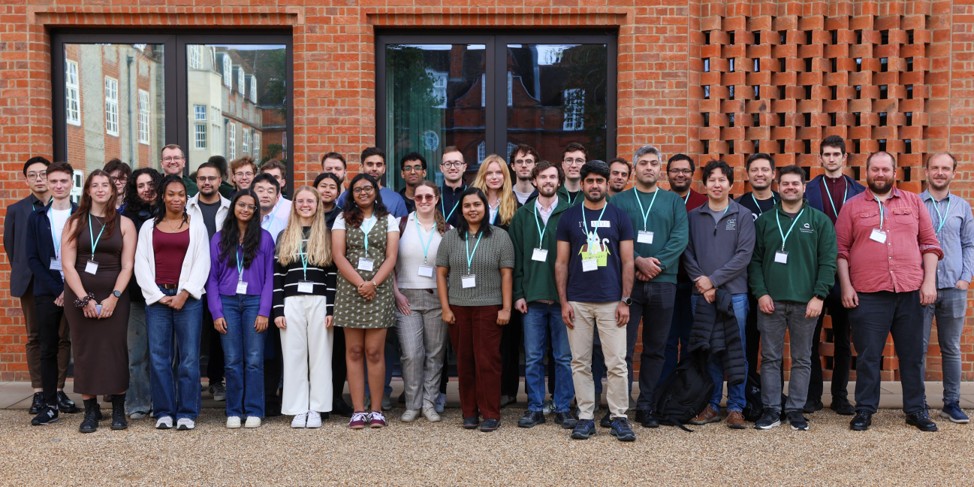
Thirty participants gathered at Newnham College, Cambridge, for an intensive five-day programme exploring how quantum computers can be used to model chemical systems.
By: Duncan Gowland, Senior Advanced R&D Scientist at Quantinuum
For 30 researchers who gathered at Newnham College, Cambridge this September, that question shaped an intensive five-day programme.
Quantinuum’s first InQuanto Summer School, supported by the UK’s National Quantum Computing Centre (NQCC), combined lectures, hands-on workshops, and mini-projects to help participants connect fundamental concepts with practical research. By the end of the week, participants were applying those ideas to problems ranging from molecular electronic structure to quantum state-preparation circuits.
Applying quantum computing to chemistry can be challenging because it draws on expertise from a broad range of areas, including electronic structure theory, quantum algorithms, software, hardware, noise modelling, and resource estimation. Researchers often enter the field with deep knowledge of one or two of these areas but less familiarity with the others.
A key objective of the course was to help researchers from computational chemistry and quantum computing build stronger foundations, develop a shared language, and deepen their understanding of adjacent disciplines.
For researchers beginning work at this intersection, that shared understanding can make it easier to identify where to start, which assumptions to challenge, and when to seek expertise from another discipline.
Bringing Theory and Practice Together
The programme began with lectures on the foundations of quantum computing, followed by pen-and-paper and computational exercises in the afternoon. On Day 2, lectures and workshops introduced the electronic structure problem: how quantum chemists describe the behaviour of electrons in molecules.
Students then brought these two foundations together by studying fermion-to-qubit mappings, which translate chemistry problems into a form that quantum computers can process, before moving on to the measurement of chemistry observables and the construction of quantum algorithms.
Learners were given free access to InQuanto, Quantinuum’s quantum chemistry software platform designed to accelerate research in fields such as chemistry and condensed matter physics using quantum computers. InQuanto supported the lectures as a broad, well-documented, and thoroughly tested platform that enabled students to explore and reinforce complex concepts through hands-on experience.
Later in the week, attention shifted to state-of-the-art considerations: how to build useful chemical models, make the best use of current quantum devices, and think about how quantum algorithms for chemistry might develop over the next five to ten years.
The students, who travelled from around the world to Cambridge, brought a remarkable range of backgrounds and experience. The material was pitched at roughly first-year doctoral level, for participants with at least a year of experience in one core area and some Python skills. Even with this experience, participants benefited from exposure to other disciplines and from the practical expertise of Quantinuum’s quantum chemistry team—which brings years of experience working with industrial including BMW Group, TotalEnergies, NVIDIA, and Pfizer.
Throughout the week, participants were highly engaged in lectures and brought a thoughtful, collaborative approach to the workshop exercises. Discussions continued throughout the week, from coffee breaks to lunches and dinners, creating valuable opportunities to exchange ideas and experiences.
A particular highlight was the mini-project work. In just a day and a half, participants tackled a wide range of problems and produced impressive prototype solutions. The projects concluded with a poster-style session, where the quality of discussion was exceptional. Examples included state-preparation programmes using mid-circuit measurement in Guppy; investigations of active-space selection and quantum-selected configuration interaction (QSCI) for the chromium dimer; and the use of the atomic valence active space (AVAS) approach to identify active spaces and perform resource estimation for myoglobin.
One participant reimplemented their research on efficient state-preparation circuits based on orbital entanglement in InQuanto and compared the performance of those circuits with the platform’s efficient ansatz methods on the Helios emulator. It was rewarding to see participants apply these tools to their own research challenges and explore new approaches to quantum chemistry.
With Support from the UK’s National Quantum Computing Centre
This rewarding week was made possible through the support of the UK’s National Quantum Computing Centre, whose partnership helped bring the programme to life, and by the contributions of colleagues across Quantinuum. The teaching team brought together experts from our quantum chemistry, compiler, and error-correction teams, who developed the course materials, delivered lectures, and led the workshops.
Above all, the programme demonstrated the value of bringing researchers together around a shared foundation, practical tools, and opportunities to learn from one another. We look forward to seeing how participants build on these ideas in their future research.
Interested in future training opportunities, workshops, and community events from Quantinuum? Join QNET to stay connected with the latest updates, resources, and opportunities to engage with the quantum computing community.