Blog

‍

Discover how we are pushing the boundaries in the world of quantum computing

Thank you! Your submission has been received!
Oops! Something went wrong while submitting the form.
partnership
All
March 16, 2026
partnership
Real Time Error Correction at Increased Scale

As quantum computing power grows, so does the difficulty of error correction. Meeting that demand requires tight integration with high-performance classical computing, which is why we’ve partnered with NVIDIA to push the boundaries of real-time decoding performance.

Realizing the full power of quantum computing requires more than just qubits, it requires error rates low enough to run meaningful algorithms at scale. Physical qubits are sensitive to noise, which limits their capacity to handle calculations beyond a certain scale. To move beyond these limits, physical qubits must be combined into logical qubits, with errors continuously detected and corrected in real time before they can propagate and corrupt the calculation. This approach, known as fault tolerance, is a foundational requirement for any quantum computer intended to solve problems of real-world significance.

Part of the challenge of fault tolerance is the computational complexity of correcting errors in real time. Doing so involves sending the error syndrome data to a classical co-processor, solving a complex mathematical problem on that processor, then sending the resulting correction back to the quantum processor - all fast enough that it doesn’t slow down the quantum computation. For this reason, Quantum Error Correction (QEC) is currently one of the most demanding use-cases for tight coupling between classical and quantum computing.

Given the difficulty of the task, we have partnered with NVIDIA, leaders in accelerated computing. With the help of NVIDIA’s ultra-fast GPUs (and the GPU-accelerated BP-OSD decoder developed by NVIDIA as part of NVIDIA CUDA-Q QEC library), we were able to demonstrate real-time decoding of Helios’ qubits, all in a system that can be connected directly to our quantum processors using NVIDIA NVQLink.

While real-time decoding has been demonstrated before (notably, by our own scientists in this study), previous demonstrations were limited in their scalability and complexity.

In this demonstration, we used Brings’ code, a high-rate code that is possible with our all-to-all connectivity, to encode our physical qubits into noise-resilient logical qubits. Once we had them encoded, we ran gates as well as let them idle to see if we could catch and correct errors quickly and efficiently. We submitted the circuits via both NVIDIA CUDA-Q as well as our own Guppy language, underlining our commitment to accessible, ecosystem-friendly quantum computing.

The results were excellent: we were able to perform low-latency decoding that returned results in the time we needed, even for the faster clock cycles that we expect in future generation machines.

A key part of the achievement here is that we performed something called “correlated” decoding. In correlated decoding, you offload work that would normally be performed on the QPU onto the classical decoder. This is because, in ‘standard’ decoding, as you improve your error correction capabilities, it takes more and more time on the QPU. Correlated decoding elides this cost, saving QPU time for the tasks that only the quantum computer can do.

Stay tuned for our forthcoming paper with all the details.
events
All
March 9, 2026
events
APS Global Physics Summit 2026

Every year, APS Global Physics Summit brings together scientific community members from around the world across all disciplines of physics.

Join Quantinuum at this year’s conference, taking place in our backyard, Denver, Colorado, from March 15th – 20th, where we will showcase how our quantum hardware, software, and partnerships are helping define the next era of high-performance and quantum computing.

Find our team at booth #1020 and join our sessions below to discover how we’re advancing quantum technologies and building the bridge between HPC and quantum.

Monday, March 16th

Programmable quantum matter at the frontier of classical computation
Speaker: Andrew Potter
Time: 10:12 – 10:48 am

Benchmarking a 98-qubit trapped-ion quantum computer
Speaker: Charles Baldwin
Time: 12:36 – 12:48 pm

High-Fidelity Quantum operations in the Helios Barium-Ion Processor
Speaker: Anthony Ransford
Time: 4:18 – 4:30 pm

Generative AI Model for Quantum State Preparation
Speaker: Jem Guhit
Time: 4:42 – 4:54 pm

Quantum digital simulations of holographic models using Quantinuum Systems
Speaker: Enrico Rinaldi
Time: 5:54 – 6:30 pm

Tuesday, March 17th

Software-Enabled Innovations that Drive Robust Commercial Operation on Quantinuum Helios
Speaker: Caroline Figgatt
Time: 8:00 – 8:12 am

Improving Clock Speed in the Quantinuum Helios Quantum Computer
Speaker: Adam Reed
Time: 8:12 – 8:24 am

Less Quantum, More Advantage: An End-to-End Quantum Algorithm for the Jones Polynomial
Speaker: Konstantinos Meichanetzidis
Time: 8:48 – 9:00 am

Quantum Operation Pipelining in the Quantinuum Helios Processor
Speaker: Colin Kennedy
Time: 9:00 - 9:12 am

Directly estimating the fidelity of measurement-based quantum computation
Speaker: David Stephen
Time: 9:12 - 9:24 am

Logical algorithms in a quantum error-detecting code on a trapped-ion quantum processor
Speaker: Matthew DeCross
Time: 9:36 - 9:48 am

Separate and efficient characterization of SPAM errors in the presence of leakage
Speaker: Leigh Norris
Time: 10:00 - 10:12 am

Logical benchmarking on a trapped-ion quantum processor
Speaker: Andrew Guo
Time: 12:00 - 12:12 pm

Modelling Actinides Chemistry with Trapped Ion Quantum Computers
Speaker: Carlo Alberto Gaggioli
Time: 3:30 - 3:42 pm

Wednesday, March 18th

Digital quantum magnetism at the frontier of classical simulation
Speaker: Michael Foss-Feig
Time: 8:36  - 9:12 am

Shorter width truncated Taylor series for Hamiltonian dynamics simulations
Speaker: Michelle Wynne Sze
Time: 9:24 - 9:36 am

Quantum-Accelerated DFT+DMFT for Correlated Subspaces in Hemoglobin
Speaker: Juan Pedersen 
Time: 9:48 - 10:00 am

Simple logical quantum computation with concatenated symplectic double codes
Speaker: Noah Berthusen
Time: 12:48 - 1:00 pm

When is enough enough? Efficient estimation of quantum properties by stopping early
Speaker: Oliver Hart
Time: 12:48 - 1:00 pm

High-Level Programming of the Quantinuum Helios Processor
Speaker: John Campora
Time: 1:48 - 2:24 pm

Error detection without post-selection in adaptive quantum circuits 
Speaker: Eli Chertkov
Time: 4:42 - 4:54 pm

Thursday, March 19th

Below Threshold Logical Quantum Computation at Quantinuum
Speaker: Shival Dasu
Time: 8:00 - 8:36 am

Performing optimal phase measurements with a universal quantum processor
Speaker: Ross Hutson
Time: 8:36 - 8:48 am

Benchmarking with leakage heralded measurements on the Quantinuum Helios processor
Speaker: Victor Colussi
Time: 10:00 am

High-throughput bidirectional microwave-to-optical transduction assessed with a practical quantum capacity
Speaker: Maxwell Urmey
Time: 12:00 - 12:36 pm

Fast quantum state preparation via AI-based Graph Decimation
Speaker: Matteo Puviani
Time: 5:54 - 6:06 pm

Friday, March 20th

2D Tensor Network Methods for Simulation of Spin Models on Quantum Computers
Speaker: Reza Haghshenas
Time: 8:36 - 8:48 am

High-Performance Computing Simulations for Optical Multidimensional Coherent Spectroscopy Studies of Strained Silicon-Vacancy Centers in Diamond
Speaker: Imran Bashir
Time: 10:36 - 10:48 am

High-Performance Statevector Simulation for TKET and Selene with NVIDIA cuStateVec
Speaker: Fabian Finger
Time: 12:36 - 12:48 pm

Part 1: Logic gates on High-rate Quantum LDPC codes using ion trap devices
Speaker: Elijah Durso-Sabina
Time: 12:48 - 1:00 pm

Driving Quantum Computing Forward: QEC, Hardware, and Applications with Quantinuum
Speaker: Natalie Brown
Time: 1:12 - 1:48 pm

A new QCCD computer and new applications
Speaker: Anthony Ransford
Time: 2:24 - 3:00 pm

*All times in MT

technical
All
March 4, 2026
technical
Skinny Logic: Quantum Codes Go on a Diet

In our latest paper, we’ve taken a big step toward large scale fault-tolerant quantum computing, squeezing up to 94 error-detected qubits (and 48 error-corrected qubits) out of just 98 physical qubits, a low-fat encoding that cuts overhead to the bone. With 64 of our logical qubits, we were able to simulate quantum magnetism at a scale that can be exceedingly difficult for classical computers.

The "holy grail" of quantum computing is universal fault-tolerance: the ability to correct errors faster than they occur during any computation. To realize this, we aim to create “logical qubits,” which are groups of entangled physical qubits that share quantum information in a way that protects it. Better protection leads to lower “logical” error rate and greater ability to solve complex problems.

However, it’s never that easy. An unofficial law of physics is “there’s no such thing as a free lunch”. Creating high quality, low error-rate logical qubits often costs many physical qubits, thus reducing the size of calculations you can run, despite your new, lower-than-ever error rates.

With our latest paper, we are thrilled to announce that we have hit a key milestone on the Quantinuum roadmap: an ultra-efficient method for creating logical qubits, extracting a whopping 48 error-corrected and 64 error-detected logical qubits out of just 98 physical qubits. Our logical qubits boasted better than “break-even” fidelity, beating their physical counterparts with lower error rates on several different fronts. And still that isn’t the end of the story: we used our 64 error-detected logical qubits in a large-scale quantum magnetism simulation, laying the groundwork for future studies of exotic interactions in materials.

Stacking Wins

To get this world-leading result, we employed a neat trick: ‘nesting’ super efficient quantum error-detecting codes together to make a new, ultra-efficient error-correcting code. Dr. DeCross, a primary author on the paper, said this nesting is like “braiding together ropes made out of ropes made out of ropes”.  Physicists call this ‘code concatenation’, and you can think of it as adding layers of protection on top of each other.

To begin, we took the now-famous ‘iceberg code’, a quantum error detection code that gives an almost 1:1 ratio of physical qubits to logical qubits. The iceberg code only detects errors, however, which means that instead of actually correcting errors it lets you throw out bits where errors were detected. To make a code that could both detect and correct errors, we concatenated two iceberg codes together, giving a code that can correct small errors while still boasting a world-record 2:1 physical:logical ratio (physicists call this a “high encoding rate”).

The team then benchmarked the logical qubits, checking large system-scale operations and comparing them to their physical counterparts. This introduces a crucial hurdle to clear: oftentimes, researchers end up with logical qubits that perform *worse* than their physical counterparts. It’s critical that logical qubits actually beat physical ones, after all – that is the whole point!

Thanks to some clever circuit design and our natively high fidelities, the new logical qubits outperformed their physical counterparts in every test we performed, sometimes by a factor of 10 to 100.

Computing Logically

Of course, the whole point is to use our logical qubits for something useful, the ultimate measure of functionality. With 64 error-detected qubits, we performed a simulation of quantum magnetism; a crucial milestone that validates our roadmap.

The team took extra care to perform their simulation in 3 dimensions to best reflect the real-world (often, studies like this will only be in 1D or 2D to make them easier). Problems like this are both incredibly important for expanding our understanding of materials, but are also incredibly hard, as their complexity scales quickly. To make qubits interact as if they are in a 3D material when they are trapped in 2D inside the computer, we used our all-to-all connectivity, a feature that results from our movable qubits.

Maximizing Entanglement

Breaking the encoding rate record and performing a world-leading logical simulation wasn’t enough for the team. For their final feat, the team generated 94 error-detected logical qubits, and entangled them all in a special state called a “GHZ” state (also known as a ‘cat’ state, alluding to Schrödinger’s cat). GHZ states are often used by experts as a simple benchmark for showcasing quantum computing’s unique capacity to use entanglement across many qubits. Our best 94-logical qubit GHZ state boasted a fidelity of 94.9%, crushing its un-encoded counterpart.

Logical Qubits Are the New Normal

Taken together, these results show that we can suppress errors more effectively than ever before, proving that Helios is capable of delivering complex, high-fidelity operations that were previously thought to be years away. While the magnetism simulation was only error-detected, it showcases our ability to protect universal computations with partially fault-tolerant methods. On top of that, the team also demonstrated key error-corrected primitives on Helios at scale.

All of this has real-world implications for the quantum ecosystem: we are working to package these iceberg codes into QCorrect, an upcoming tool that will help developers automatically improve the performance of their own applications.

This is just the beginning: we are officially entering the era of large-scale logical computing. The path to fault-tolerance is no longer just theoretical—it is being built, gate by gate, on Helios.

technical
All
partnership
All
March 2, 2026
technical
partnership
トラップイオンを用いたハイブリッド量子・HPCコンピューティングの幕開け

日本は、ハイパフォーマンスコンピューティング(HPC)と量子技術の両分野において、大胆かつ戦略的な投資を行ってきました。これらの技術が成熟するにつれ、政策立案者や研究リーダーの間では、「高度なマシンを構築する段階から、有意義で統合された活用事例を実証する段階へどう移行するか」という重要な問いが浮上しています。

昨年、Quantinuumは量子コンピュータ「Reimei」を、日本最大級の総合研究機関である理化学研究所の施設に設置しました。このシステムは、経済産業省所管の国立研究開発法人である新エネルギー・産業技術総合開発機構(NEDO)が委託する野心的な国家プロジェクトの一環として、世界最高峰の性能を誇るスーパーコンピュータ「富岳」と統合されました。

今回、世界屈指のスーパーコンピュータ「富岳」と、当社のトラップイオン量子コンピュータ「Reimei」を跨いだ完全な科学的ワークフローの実行に初めて成功しました。これは、インフラ開発の段階から実用的な展開の段階へと移行したことを意味します。

量子生物学

HPCと量子コンピューティングを組み合わせたこの初の試みにおいて、研究チームはタンパク質などの生体分子内で起こる化学反応を調査しました。こうした反応は、酵素の機能から薬物相互作用に至るまで、生物学のあらゆる場面で見られます。

このような反応を正確にシミュレーションすることは極めて困難です。化学反応が起こる領域である「活性中心」では、わずかな電子的な影響が結果を左右するため、非常に高い精度が求められます。同時に、この活性中心はより大きな分子環境の中に埋め込まれており、その環境も(通常はより低い詳細度で)表現する必要があります。

この複雑な課題に対処するため、計算化学では長年、システムの各部分を異なる手法で処理する階層的なアプローチがとられてきました。今回の研究では、古典的なスーパーコンピューティングと量子コンピューティングを組み合わせることで、この概念をハイブリッドコンピューティングの時代へと拡張しました。

パラダイムの転換

量子コンピューティングの長期的な目標は古典的な手法を単独で凌駕することですが、本プロジェクトの目的は、実際の科学的アプリケーションに向けたエンドツーエンドのプラットフォームとして、完全に機能するハイブリッドシステムを実証することにありました。ハードウェアを単独で開発するだけでは不十分であり、古典リソースと量子リソースが組み合わさることで、個々の総和以上の価値を生み出すワークフローを構築しなければなりません。私たちは、これが業界にとって極めて重要な一歩であると考えています。量子コンピューティングへの大規模な国家投資は、最終的にその技術を既存の研究インフラにどのように組み込めるかを示す必要があります。

今回の研究では、スーパーコンピュータ「富岳」が幾何構造の最適化とベースラインとなる電子状態計算を担当しました。量子コンピュータ「Reimei」は、従来の近似手法では困難とされる活性中心の最も複雑な電子相互作用の処理を強化するために使用されました。プロセス全体は、Quantinuumのワークフローシステムである Tierkreisによって調整され、マシン間で効率的にジョブを移動させることが可能となりました。

ハイブリッドコンピューティングは今、実用段階へ

このインフラが整ったことで、私たちは量子コンピューティングの真の力を活用する準備が整いました。今回の事例では、量子ハードウェアと古典ハードウェア双方の強みを最大限に引き出すようアルゴリズムが設計されています。

まず、古典コンピュータが分子システムの近似的な記述を構築します。次に、古典コンピュータでは扱いきれない詳細な量子力学のモデリングに量子コンピュータを使用します。これらを組み合わせることで精度が向上し、古典システムの有用性が拡張されます。

ハイブリッド・アドバンテージへの道筋

生体分子反応の正確なシミュレーションは、生化学における主要な課題の一つです。本研究では手法に焦点を当てるため簡略化されたシステムを用いていますが、これは創薬、酵素工学、光活性生物システムといった将来の応用分野に向けた基盤となるものです。

完全な耐故障性を備えた大規模量子コンピュータの開発は現在も進行中ですが、ハイブリッドアプローチを用いることで、今日の量子ハードウェアを「富岳」のような強力な古典システムと組み合わせ、有意義な応用を探求することが可能になっています。量子技術の成熟に伴い、これらのワークフローも同様に拡張していくことが可能です。

世界中のハイパフォーマンスコンピューティングセンターでは、量子デバイスを自社のエコシステムにどのように統合できるか、活発な検討が行われています。本研究は、異種アーキテクチャ間での調整されたジョブスケジューリング、ハードウェアへの直接アクセス、ワークフローのオーケストレーションを実証することで、そのような統合を実現するための具体的な例を提示します。

量子ハードウェアの成熟に伴い、ここで開発されたアルゴリズムやワークフローは、より現実的で産業に関連性の高い問題へと拡張できると考えています。日本の研究エコシステムにとって、この最初の応用マイルストーンは、ハイブリッド量子・スーパーコンピューティングが「野心」から「実装」の段階へと移行していることを示しています。

technical
All
December 11, 2025
technical
Automated Quantum Algorithm Discovery for Quantum Chemistry

Authors: 
Quantinuum (alphabetical order): Eric Brunner, Steve Clark, Fabian Finger, Gabriel Greene-Diniz, Pranav Kalidindi, Alexander Koziell-Pipe, David Zsolt Manrique, Konstantinos Meichanetzidis, Frederic Rapp
Hiverge (alphabetical order): Alhussein Fawzi, Hamza Fawzi, Kerry He, Bernardino Romera Paredes, Kante Yin

‍

What if every quantum computing researcher had an army of students to help them write efficient quantum algorithms? Large Language Models are starting to serve as such a resource.

Quantinuum’s processors offer world-leading fidelity, and recent experiments show that they have surpassed the limits of classical simulation for certain computational tasks, such as simulating materials. However, access to quantum processors is limited and can be costly. It is therefore of paramount importance to optimise quantum resources and write efficient quantum software. Designing efficient algorithms is a challenging task, especially for quantum algorithms: dealing with superpositions, entanglement, and interference can be counterintuitive.

To this end, our joint team used Hiverge’s AI platform for automated algorithm discovery, the Hive, to probe the limits of what can be done in quantum chemistry. The Hive generates optimised algorithms tailored to a given problem, expressed in a familiar programming language, like Python. Thus, the Hive’s outputs allow for increased interpretability, enabling domain experts to potentially learn novel techniques from the AI-discovered solutions. Such AI-assisted workflows lower the barrier of entry for non-domain experts, as an initial sketch of an algorithmic idea suffices to achieve state-of-the-art solutions.

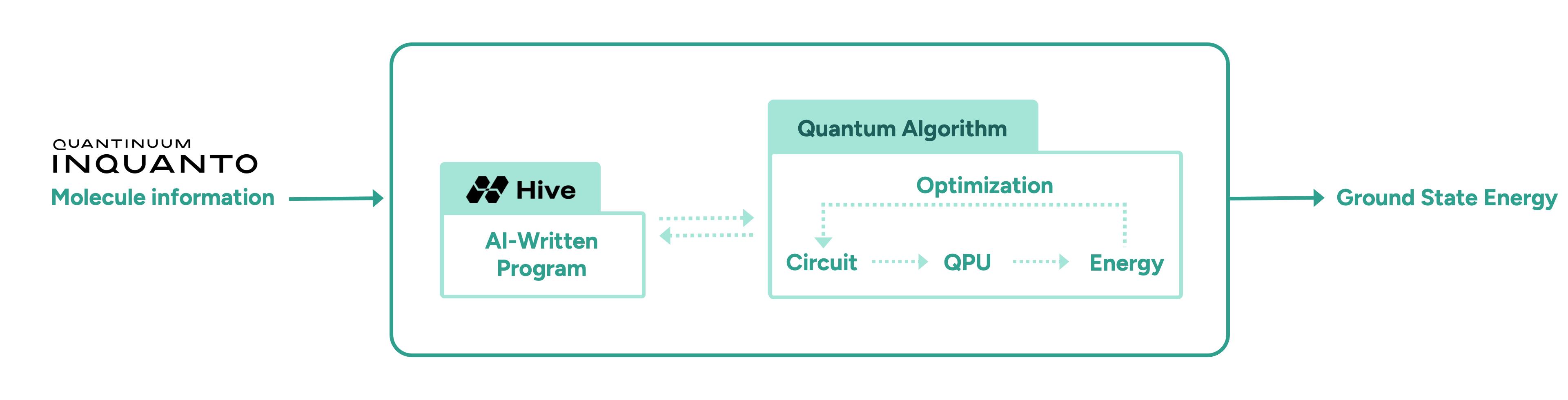
In this initial proof-of-concept study, we demonstrate the advantage of AI-driven algorithmic discovery of efficient quantum heuristics in the context of quantum chemistry, in particular the electronic structure problem. Our early explorations show that the Hive can start from a naïve and simple problem statement and evolve a highly optimised quantum algorithm that solves the problem, reaching chemical precision for a collection of molecules. Our high-level workflow is shown in Figure 1. Specifically, the quantum algorithm generated by the Hive achieves a reduction in the quantum resources required by orders of magnitude compared to current state-of-the-art quantum algorithms. This promising result may enable the implementation of quantum algorithms on near-term hardware that was previously thought impossible due to current resource constraints.

Figure 1: Workflow: A scientist prompts Hiverge's platform, the Hive, with the molecule of interest and a sketch of a quantum algorithm. The goal of the quantum algorithm is to find the ground state energy of the molecule. The Hive evolves the sketch into an efficient version that solves the problem.
The Electronic Structure Problem in Quantum Chemistry

The electronic structure problem is central to quantum chemistry. The goal is to prepare the ground state (the lowest energy state) of a molecule and compute the corresponding energy of that state to chemical precision or beyond. Classically, this is an exponentially hard problem. In particular, classical treatments tend to fall short when there are strong quantum effects in the molecule, and this is where quantum computers may be advantageous.

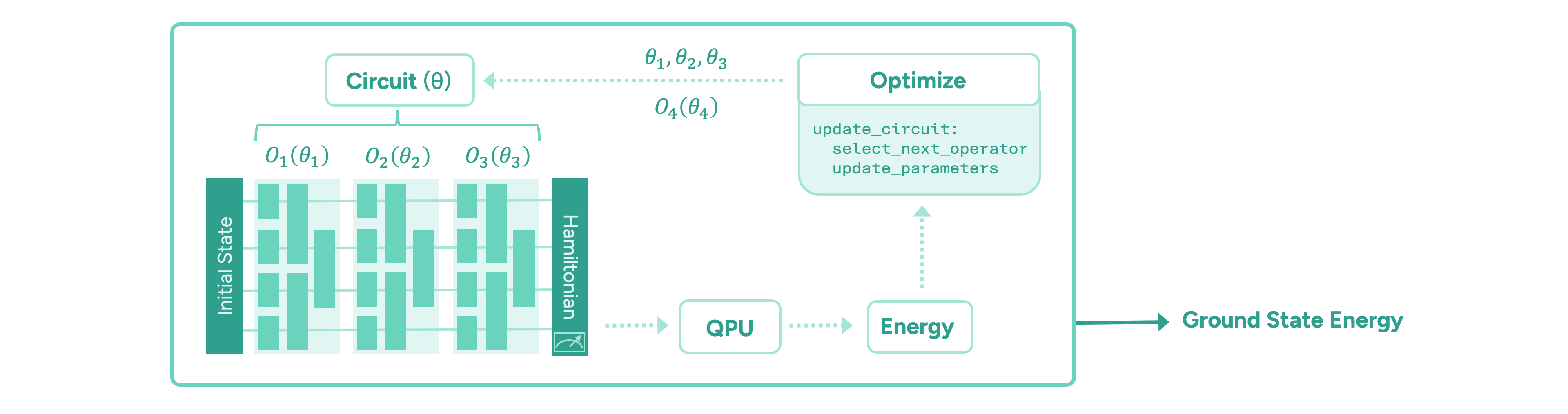
The paradigm of variational quantum algorithms is motivated by near-term quantum hardware. One starts with a relatively easy-to-prepare initial state. Then, the main part of the algorithm consists of a sequence of parameterised operators representing chemically meaningful actions, such as manipulating electron occupations in the molecular orbitals. These are implemented in terms of parameterised quantum gates. Finally, the energy of the state is measured via the molecule’s energy operator, the “Hamiltonian”, by executing the circuit on a quantum computer and measuring all the qubits on which the circuit is implemented. Taking many measurements, or “shots”, the energy is estimated to the desired precision. The ground state energy is found by iteratively optimising the parameters of the quantum circuit until the energy converges to a minimum value. The general form of such a variational quantum algorithm is illustrated in Figure 2.

Figure 2: A variational quantum algorithm is defined by a function select_next_operator that iteratively constructs a parameterised quantum circuit as a sequence of operators [O1(θ1),O2(θ2),O3(θ3), ...], and a function update_parameters that optimises its parameters; these functions update the quantum circuit and refine it to its final form that prepares the ground state. The Hive evolves sophisticated versions of these functions starting from trivial versions, written in a familiar programming language, producing a novel, efficient variational quantum algorithm that solves the problem.

The main challenge in these frameworks is to design an appropriate quantum circuit architecture, i.e. find an efficient sequence of operators, and an efficient optimisation strategy for its parameters. It is important to minimise the number of quantum operations in any given circuit, as each operation is inherently noisy and the algorithm’s output degrades exponentially. Another important quantum resource to be minimised is the total number of circuits that need to be evaluated to compute the energy values during the optimisation of the circuit parameters, which is time-consuming.

To meet these challenges, we task the Hive with designing a variational quantum algorithm to solve the ground state problem, following the workflow shown in Figure 1. The Hive is a distributed evolutionary process that evolves programs. It uses Large Language Models to generate mutations in the form of edits to an entire codebase. This genetic process selects the fittest programs according to how well they solve a given problem. In our case, the role of the quantum computer is to compute the fitness, i.e., the ground state energy. Importantly, the Hive operates at the level of a programming language; it readily imports and uses all known libraries that a human researcher would use, including Quantinuum’s quantum chemistry platform, InQuanto. In addition, the Hive can accept instructions and requests in natural language, increasing its flexibility. For example, we encouraged it to seek parameter optimisation strategies that avoid estimating gradients, as this incurs significant overhead in terms of circuit evaluations.  Intuitively, the interaction between a human scientist and the Hive is analogous to a supervisor and a group of eager and capable students: the supervisor provides guidance at a high level, and the students collaborate and flesh out the general idea to produce a working solution that the supervisor can then inspect.

We find that from an extremely basic starting point, consisting of a skeleton for a variational quantum algorithm, the Hive can autonomously assemble a bespoke variational quantum algorithm, which we call Hive-ADAPT. Specifically, the Hive evolves heuristic functions that construct a circuit as a sequence of quantum operators and optimise its parameters. Remarkably, the Hive converged on a structure resembling the current state-of-the-art, ADAPT-VQE. Crucially, however, Hive-ADAPT substantially outperforms this baseline, delivering significant improvements in chemical precision while reducing quantum resource requirements.

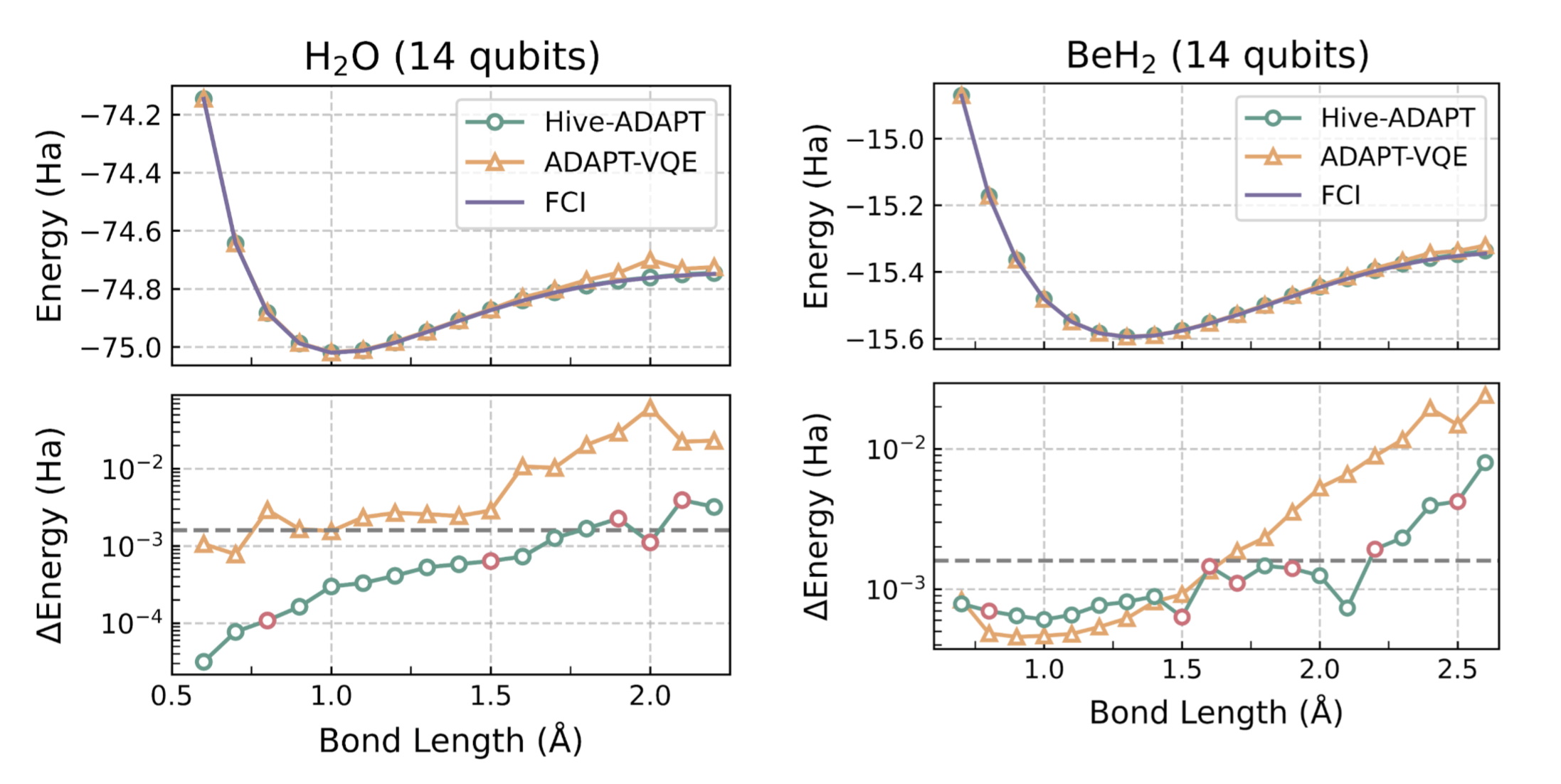
Figure 3: (Top): The measured ground state energy of the molecule in Hartree (Ha) as a function of the bond length in Angstrom (Å), i.e. the length of the O-H and Be-H bonds in H2O and BeH2, respectively. Both ADAPT-VQE and Hive-ADAPT recover the energy curve. (Bottom): The difference between the energy estimated by the quantum algorithms and the reference value computed with the exact FCI method. Hive-ADAPT achieves chemical precision for more bond lengths than ADAPT-VQE (energy below dashed flat lines). Hive-ADAPT was evolved by the Hive to solve a particular set of bond lengths (red circles), and we observe that the same algorithm can also solve the problem on other bond lengths (green circles), showing generalisation over bond lengths.

A molecule’s ground state energy varies with the distances between its atoms, called the “bond length”. For example, for the molecule H2O, the bond length refers to the length of the O-H bond. The Hive was tasked with developing an algorithm for a small set of bond lengths and reaching chemical precision, defined as within 1.6e-3 Hartree (Ha) of the ground state energy computed with the exact Full Configuration Interaction (FCI) algorithm. As we show in Figure 3, remarkably, Hive-ADAPT achieves chemical precision for more bond lengths than ADAPT-VQE. Furthermore, Hive-ADAPT also reaches chemical precision for other “unseen” bond lengths, showcasing the generalisation ability of the evolved quantum algorithm. Our results were obtained from classical simulations of the quantum algorithms, where we used NVIDIA CUDA-Q to leverage the parallelism enabled by GPUs. Further, relative to ADAPT-VQE, Hive-ADAPT exhibits one to two orders of magnitude reduction in quantum resources, such as the number of circuit evaluations and the number of operators used to construct circuits, which is crucial for practical implementations on actual near-term processors.

For molecules such as BeH2 at large Be-H bond lengths, a complex initial state is required for the algorithm to be able to reach the ground state using the available operators. Even in these cases, by leveraging an efficient state preparation scheme implemented in InQuanto, the Hive evolved a dedicated strategy for the preparation of such a complex initial state, given a set of basic operators to achieve the desired chemical precision.

To validate Hive-ADAPT under realistic conditions, we employed Quantinuum’s H2 Emulator, which provides a faithful classical simulator of the H2 quantum computer, characterised by a 1.05e-3 two-qubit gate error rate. Leveraging the Hive's inherent flexibility, we adapted the optimisation strategy to explicitly penalise the number of two-qubit gates—the dominant noise source on near-term hardware—by redefining the fitness function. This constraint guided the Hive to discover a noise-aware algorithm capable of constructing hardware-efficient circuits. We subsequently executed the specific circuit generated by this algorithm for the LiH molecule at a bond length of 1.5 Å with the Partition Measurement Symmetry Verification (PMSV) error mitigation procedure. The resulting energy of -7.8767 ± 0.0031 Ha, obtained using 10,000 shots per circuit with a discard rate below 10% in the PMSV error mitigation procedure, is close to the target FCI energy of -7.8824 Ha and demonstrates the Hive's ability to successfully tailor algorithms that balance theoretical accuracy with the rigorous constraints of hardware noise and approach chemical precision as much as possible with current quantum technology.

For illustration purposes, we show an example of an elaborate code snippet evolved by the Hive starting from a trivial version:

Quantinuum’s in-house quantum chemistry expert, Dr. David Zsolt Manrique, commented,

“I found it amazing that the Hive converged to a domain-expert level idea. By inspecting the code, we see it has identified the well-known perturbative method, ‘MP2’, as a useful guide; not only for setting the initial circuit parameters, but also for ordering excitations efficiently. Further, it systematically and laboriously fine-tuned those MP2-inspired heuristics over many iterations in a way that would be difficult for a human expert to do by hand. It demonstrated an impressive combination of domain expertise and automated machinery that would be useful in exploring novel quantum chemistry methods.”
Looking to the Future

In this initial proof-of-concept collaborative study between Quantinuum and Hiverge, we demonstrate that AI-driven algorithm discovery can generate efficient quantum heuristics. Specifically, we found a great reduction in quantum resources, which is impactful for quantum algorithmic primitives that are frequently reused. Importantly, this approach is highly flexible; it can accommodate the optimisation of any desired quantum resource, from circuit evaluations to the number of operations in a given circuit. This work opens a path toward fully automated pipelines capable of developing problem-specific quantum algorithms optimised for NISQ as well as future hardware.

An important question for further investigation regards transferability and generalisation of a discovered quantum solution to other molecules, going beyond the generalisation over bond lengths of the same molecule that we have already observed. Evidently, this approach can be applied to improving any other near-term quantum algorithm for a range of applications from optimisation to quantum simulation.

We have already demonstrated an error-corrected implementation of quantum phase estimation on quantum hardware, and an AI-driven approach promises further hardware-tailored improvements and optimal use of quantum resources. Beyond NISQ, we envision that AI-assisted algorithm discovery will be a fruitful endeavour in the fault-tolerant regime, as well, where high-level quantum algorithmic primitives (quantum fourier transform, amplitude amplification, quantum signal processing, etc.) are to be combined optimally to achieve computational advantage for certain problems.

Notably, we’ve entered an era where quantum algorithms can be written in high-level programming languages, like Quantinuum’s Guppy, and approaches that integrate Large Language Models directly benefit. Automated algorithm discovery is promising for improving routines relevant to the full quantum stack, for example, in low-level quantum control or in quantum error correction.

partnership
All
November 17, 2025
partnership
Quantinuum Powering Hybrid Quantum AI Supercomputing with NVIDIA

Quantinuum is focusing on redefining what’s possible in hybrid quantum–classical computing by integrating Quantinuum’s best-in-class systems with high-performance NVIDIA accelerated computing to create powerful new architectures that can solve the world’s most pressing challenges. 

The launch of Helios, Powered by Honeywell, the world’s most accurate quantum computer, marks a major milestone in quantum computing. Helios is now available to all customers through the cloud or on-premise deployment. Helios was launched to be compatible with NVIDIA Grace Blackwell platform, enabling real-time algorithmic error decoding

We are also working with NVIDIA to adopt  NVIDIA NVQLink, an open system architecture, as a standard for advancing hybrid quantum-classical supercomputing. Using this technology with Quantinuum Guppy and the NVIDIA CUDA-Q platform, Quantinuum has implemented NVIDIA accelerated computing across Helios and future systems to perform real-time decoding for quantum error correction. 

In an industry-first demonstration, an NVIDIA GPU-based decoder integrated in the Helios control engine improved the logical fidelity of quantum operations by more than 3% — a notable gain given Helios’ already exceptionally low error rate. These results demonstrate how integration with NVIDIA accelerated computing through NVQLink can directly enhance the accuracy and scalability of quantum computation.

This unique collaboration spans the full Quantinuum technology stack. Quantinuum’s next-generation software development environment allows users to interleave quantum and GPU-accelerated classical computations in a single workflow. Developers can build hybrid applications using tools such as NVIDIA CUDA-Q, NVIDIA CUDA-QX, and Quantinuum’s Guppy, to make advanced quantum programming accessible to a broad community of innovators.

The collaboration also reaches into applied research through the NVIDIA Accelerated Quantum Computing Research Center (NVAQC), where an NVIDIA GB200 NVL72 supercomputer can be paired with Quantinuum’s Helios to further drive hybrid quantum-GPU research, including  the development of breakthrough quantum-enhanced AI applications.

A recent achievement illustrates this potential: The ADAPT-GQE framework, a transformer-based Generative Quantum AI (GenQAI) approach, uses a Generative AI model to efficiently synthesize circuits to prepare the ground state of a chemical system on a quantum computer. Developed by Quantinuum, NVIDIA, and a pharmaceutical industry leader—and leveraging NVIDIA CUDA-Q with GPU-accelerated methods—ADAPT-GQE achieved a 234x speed-up in generating training data for complex molecules. The team used the framework to explore imipramine, a molecule crucial to pharmaceutical development. The transformer was trained on imipramine conformers to synthesize ground state circuits at orders of magnitude faster than ADAPT-VQE, and the circuit produced by the transformer was run on Helios to prepare the ground state using InQuanto, Quantinuum's computational chemistry platform.

From collaborating on hardware and software integrations to GenQAI applications, the collaboration between Quantinuum and NVIDIA is building the bridge between classical and quantum computing and creating a future where AI becomes more expansive through quantum computing, and quantum computing becomes more powerful through AI.