- QUOPS is a new, architecture-agnostic benchmark designed to measure quantum performance across physical- and logical-qubit systems, using two metrics: Q (computation size) and Ω (operations per second).
- It addresses the limits of traditional metrics like qubit count, gate fidelity, and gate speed by measuring what a quantum system can actually execute successfully—including the effects of error correction, decoding, mitigation, compilation, and other system-level factors.
- QUOPS aims to create a common language for the industry, helping vendors demonstrate progress, enabling buyers and governments to make more objective procurement decisions, and giving researchers a standardized way to track progress toward utility-scale, fault-tolerant quantum computing.
Quantum computing is entering a new era. As systems move from Noisy Intermediate-Scale Quantum (NISQ) toward Fault-Tolerant Application-Scale Quantum (FASQ), traditional metrics like qubit count, gate fidelity, and gate speed are no longer enough to describe what a machine can actually deliver.
Introducing QUOPS
Developed by Sandia National Laboratories, with input from Quantinuum and NVIDIA, QUOPS—the Quantum Universal Operations Performance System—is a common, architecture-agnostic benchmark for measuring quantum performance across both physical- and logical-qubit systems on the path toward quantum utility.
QUOPS can be applied to different architectures, codes, modalities, and levels of fault tolerance. QUOPS runs the same randomized workloads across different computational shapes, measures whether each workload succeeds, identifies the boundary of a system’s capability region, and reports two summary metrics:
- Q: the largest benchmark circuit size that passes the success threshold inside a utility-motivated region. Size is defined as 2*(width)*(depth).
- Ω: the effective operations per second at that point.
The result is a direct measure of how much computation a system can perform and how quickly it can do so. Together, these measurements provide a two-dimensional view of capability while reducing system performance to a common currency: quantum operations.
Why Quantum Computing Needs a New Metric
Component-level metrics remain essential for engineering. Qubit count, two-qubit fidelity, and gate speed can reveal control errors, crosstalk, leakage, connectivity constraints, and other system limitations. But they do not necessarily predict system-level performance.
Fault tolerance makes this gap even larger. Physical operations become logical computation with the addition of logical encoding, syndrome measurement, decoding, logical gate construction, magic-state production, routing, and control. Ultimately, this means that fault tolerance expands the relevant currencies of computation. Code distance, logical fidelity, magic-state throughput, decoding, connectivity, and space-time volume can matter far more for performance than raw qubit count or individual gate speeds.
This creates a growing challenge for buyers, governments, and researchers. As organizations move from experimentation toward larger-scale and potentially on-premise quantum systems, they need to know a simple thing:
What computation can a machine actually execute successfully?
QUOPS addresses that question by measuring the integrated system rather than inferring performance from individual components.
This is particularly important as the field considers workloads requiring roughly 10⁹–10¹² operations on thousands of qubits. Today's measured capabilities are still orders of magnitude smaller; QUOPS turns that gap into a measurable quantity.
QUOPS for Procurement
QUOPS can also provide a practical layer for quantum procurement and planning.
HPC centers need to understand when quantum computing will become useful for real workloads. Customers may have a goal of procuring a system that can, for example, run a trillion error-free operations. Today, answering these questions can require complex resource estimates that depend on hardware modality, QEC code, magic-state factories, decoding, compilation, and other architectural choices.
In both cases, QUOPS provides a simpler system-level reference point: Q describes the size of computation a machine can execute, while Ω describes its effective throughput. Furthermore, because QUOPS is architecture-neutral and includes anti-gaming provisions, it can also help buyers compare competing systems without relying solely on vendor-selected metrics or announcements.
How Quantinuum stacks up
While QUOPS is a new benchmark, it has already been measured on several vendors’ hardware. This marks an important step for our industry: we can now compare vendors directly, assessing their capabilities in a way that flattens the differences introduced by modality and architecture choices.
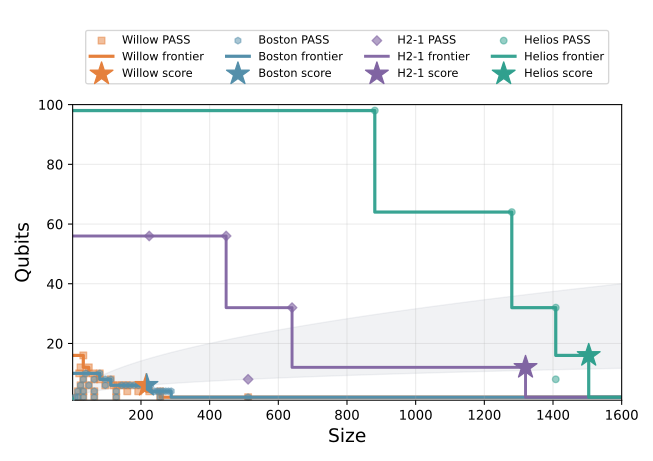
Figure 1. The QUOPS capability region and score for state-of-the-art processors from Quantinuum, Google, and IBM (adapted from Figure 2 of the scientific publication co-authored by Quantinuum, Sandia National Laboratories, and NVIDIA). QUOPS specifies a random circuit construction that can be built for a specified width (number of qubits) and size (number of quantum gates). A set of circuits is run at several width and size points and the average fidelity of those circuits are measured and compared to a predefined threshold. Each labeled point above represents experimental data from QUOPS circuits that passed the threshold with high confidence. The lines are filled capability limits of each machine between the points. The stars indicate the QUOPS score (Q), which is the experimental data point that passes the threshold with maximum size inside the shaded cone of width2 ≤ size ≤ width3.
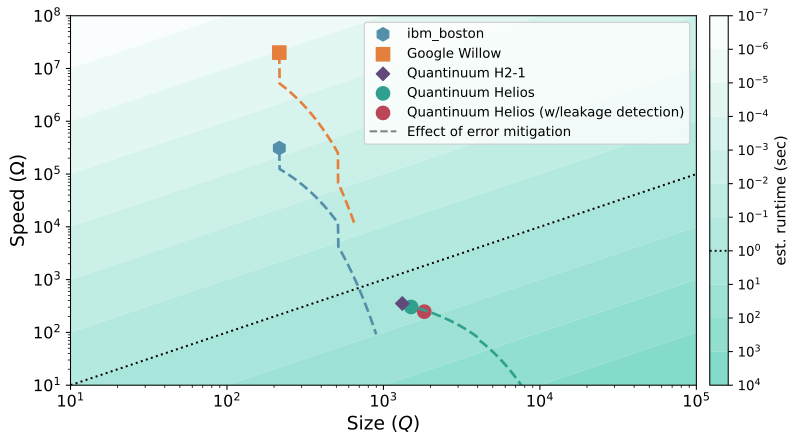
Figure 2. The QUOPS score (Q) vs rate (Ω) for state-of-the-art processors from Quantinuum, Google, and IBM (adapted from Figure 2 of the QUOPS scientific publication co-authored by Quantinuum, Sandia National Laboratories, and NVIDIA). Each point is the maximum QUOPS circuit size that passes the threshold within the specified cone and rate that it was run. The dashed lines indicate the extrapolated effect of error mitigation, which attenuates the rate by including the shot overhead needed for general-purpose error mitigation. The gradient lines show the estimated runtime of a circuit at a given score and rate.
Figures 1 and 2 show how QUOPS quantifies the capability tradeoffs between different systems. Willow and Boston are superconducting systems with very fast gate speeds but limited connectivity, while Helios is a trapped-ion QCCD system with effective all-to-all connectivity but much slower gates. Willow and Boston have smaller capability regions and QUOPS scores but higher QUOPS rates; while Helios reaches larger capability regions and QUOPS scores but lower QUOPS rates. All three systems have the ability to trade speed for larger circuits with error mitigation. This is commonly assumed in the community but is nicely quantified with the QUOPS rate, which accounts for the corresponding sampling overheads of general error mitigation techniques (as shown by the dashed lines in Figure 2).
Building a New Benchmarking Ecosystem
QUOPS will not replace every quantum benchmark. The field will continue to need application-specific suites, component-level measurements, hybrid-HPC benchmarks, and independent verification.
QUOPS instead serves as a common system-level yardstick that can make roadmaps more comparable, procurement more objective, and progress easier to track.
We are calling on vendors to report QUOPS metrics (Q, Ω) and capability regions alongside existing metrics, buyers and agencies to consider QUOPS thresholds in RFPs, and researchers to contribute fault-tolerant architectures and resource estimates.
As quantum computers become fault tolerant, success will no longer be defined simply by how many qubits a machine contains or how low its error rates are.
It will be defined by the computation the machine can deliver.
QUOPS is a step toward measuring that capability—and toward giving the quantum industry a benchmark built for the era ahead.