

Introducing InQuanto v4.0
The latest version of our advanced quantum computational chemistry platform
Quantinuum is excited to announce the release of InQuanto™ v4.0, the latest version of our advanced quantum computational chemistry software. This update introduces new features and significant performance improvements, designed to help both industry and academic researchers accelerate their computational chemistry work.
If you're new to InQuanto or want to learn more about how to use it, we encourage you to explore our documentation.
InQuanto v4.0 is being released alongside Quantinuum Nexus, our cloud-based platform for quantum software. Users with Nexus access can leverage the `inquanto-nexus` extension to, for example, take advantage of multiple available backends and seamless cloud storage.
In addition, InQuanto v4.0 introduces enhancements that allow users to run larger chemical simulations on quantum computers. Systems can be easily imported from classical codes using the widely supported FCIDUMP file format. These fermionic representations are then efficiently mapped to qubit representations, benefiting from performance improvements in InQuanto operators. For systems too large for quantum hardware experiments, users can now utilize the new `inquanto-cutensornet` extension to run simulations via tensor networks.
These updates enable users to compile and execute larger quantum circuits with greater ease, while accessing powerful compute resources through Nexus.
Quantinuum Nexus
InQuanto v4.0 is fully integrated with Quantinuum Nexus via the `inquanto-nexus` extension. This integration allows users to easily run experiments across a range of quantum backends, from simulators to hardware, and access results stored in Nexus cloud storage.
Results can be annotated for better searchability and seamlessly shared with others. Nexus also offers the Nexus Lab, which provides a preconfigured Jupyter environment for compiling circuits and executing jobs. The Lab is set up with InQuanto v4.0 and a full suite of related software, enabling users to get started quickly.
Enhanced Operator Performance
The `inquanto.mappings` submodule has received a significant performance enhancement in InQuanto v4.0. By integrating a set of operator classes written in C++, the team has increased the performance of the module past that of other open-source packages’ equivalent methods.
Like any other Python package, InQuanto can benefit from delegating tasks with high computational overhead to compiled languages such as C++. This prescription has been applied to the qubit encoding functions of the `inquanto.mappings` submodule, in which fermionic operators are mapped to their qubit operator equivalents. One such qubit encoding scheme is the Jordan-Wigner (JW) transformation. With respect to JW encoding as a benchmarking task, the integration of C++ operator classes in InQuanto v4.0 has yielded an execution time speed-up of two and a half times that of open-source competitors (Figure 1).

Figure 1. Performance comparison of Jordan Wigner (JW) operator mappings for LiH molecule in several basis sets of increasing size.
This is a substantial increase in performance that all users will benefit from. InQuanto users will still interact with the familiar Python classes such as `FermionOperator` and `QubitOperator` in v4.0. However, when the `mappings` module is called, the Python operator objects are converted to C++ equivalents and vice versa before and after the qubit encoding procedure (Figure 2). With future total integration of C++ operator classes, we can remove the conversion step and push the performance of the `mappings` module further. Tests, once again using the JW mappings scheme, show a 40 times execution time speed-up as compared to open-source competitors (Figure 1).

Figure 2. Representation of the conversion step from Python objects to C++ objects in the qubit encoding processes handled by the `inquanto.mappings` submodule in InQuanto v4.0.
Efficient classical pre-processing implementations such as this are a crucial step on the path to quantum advantage. As the number of physical qubits available on quantum computers increases, so will the size and complexity of the physical systems that can be simulated. To support this hardware upscaling, computational bottlenecks including those associated with the classical manipulation of operator objects must be alleviated. Aside from keeping pace with hardware advancements, it is important to enlarge the tractable system size in situations that do not involve quantum circuit execution, such as tensor network circuit simulation and resource estimation.
Leveraging Tensor Networks
Users with access to GPU capabilities can now take advantage of tensor networks to accelerate simulations in InQuanto v4.0. This is made possible by the `inquanto-cutensornet` extension, which interfaces InQuanto with the NVIDIA® cuTensorNet library. The `inquanto-cutensornet` extension leverages the `pytket-cutensornet` library, which facilitates the conversion of `pytket` circuits into tensor networks to be evaluated using the NVIDIA® cuTensorNet library. This extension increases the size limit of circuits that can be simulated for chemistry applications. Future work will seek to integrate this functionality with our Nexus platform, allowing InQuanto users to employ the extension without requiring access to their own local GPU resources.
Here we demonstrate the use of the `CuTensorNetProtocol` passed to a VQE experiment. For the sake of brevity, we use the `get_system` method of `inquanto.express` to swiftly define the system, in this case H2 using the STO-3G basis-set.
from inquanto.algorithms import AlgorithmVQE
from inquanto.ansatzes import FermionSpaceAnsatzUCCD
from inquanto.computables import ExpectationValue, ExpectationValueDerivative
from inquanto.express import get_system
from inquanto.mappings import QubitMappingJordanWigner
from inquanto.minimizers import MinimizerScipy
from inquanto.extensions.cutensornet import CuTensorNetProtocol


fermion_hamiltonian, space, state = get_system("h2_sto3g.h5")
qubit_hamiltonian = fermion_hamiltonian.qubit_encode()
ansatz = FermionSpaceAnsatzUCCD(space, state, QubitMappingJordanWigner())
expectation_value = ExpectationValue(ansatz, qubit_hamiltonian)
gradient_expression = ExpectationValueDerivative(
	ansatz, qubit_hamiltonian, ansatz.free_symbols_ordered()
)


protocol_tn = CuTensorNetProtocol()
vqe_tn = (
	AlgorithmVQE(
		objective_expression=expectation_value,
		gradient_expression=gradient_expression,
		minimizer=MinimizerScipy(),
		initial_parameters=ansatz.state_symbols.construct_zeros(),
	)
	.build(protocol_objective=protocol_tn, protocol_gradient=protocol_tn)
	.run()
)
print(vqe_tn.generate_report()["final_value"])

# -1.136846575472054
The inherently modular design of InQuanto allows for the seamless integration of new extensions and functionality. For instance, a user can simply modify existing code using `SparseStatevectorProtocol` to enable GPU acceleration through `inquanto-cutensornet`. It is worth noting that the extension is also compatible with shot-based simulation via the `CuTensorNetShotsBackend` provided by `pytket-cutensornet`.
“Hybrid quantum-classical supercomputing is accelerating quantum computational chemistry research,” said Tim Costa, Senior Director at NVIDIA®. “With Quantinuum’s InQuanto v4.0 platform and NVIDIA’s cuQuantum SDK, InQuanto users now have access to unique tensor-network-based methods, enabling large-scale and high-precision quantum chemistry simulations.”
Classical Code Interface
As demonstrated by our `inquanto-pyscf` extension, we want InQuanto to easily interface with classical codes. In InQuanto v4.0, we have clarified integration with other classical codes such as Gaussian and Psi4. All that is required is an FCIDUMP file, which is a common output file for classical codes. An FCIDUMP file encodes all the one and two electron integrals required to set up a CI Hamiltonian. Users can bring their system from classical codes by passing an FCIDUMP file to the `FCIDumpRestricted` class and calling the `to_ChemistryRestrictedIntegralOperator` method or its unrestricted counterpart, depending on how they wish to treat spin. The resulting InQuanto operator object can be used within their workflow as they usually would.
Exposing TKET Compilation
Users can experiment with TKET’s latest circuit compilation tools in a straightforward manner with InQuanto v4.0. Circuit compilation now only occurs within the `inquanto.protocols` module. This allows users to define which optimization passes to run before and/or after the backend specific defaults, all in one line of code. Circuit compilation is a crucial step in all InQuanto workflows. As such, this structural change allows us to cleanly integrate new functionality through extensions such as `inquanto-nexus` and `inquanto-cutensornet`. Looking forward, beyond InQuanto v4.0, this change is a positive step towards bringing quantum error correction to InQuanto.
Conclusion
InQuanto v4.0 pushes the size of the chemical systems that a user can simulate on quantum computers. Users can import larger, carefully constructed systems from classical codes and encode them to optimized quantum circuits. They can then evaluate these circuits on quantum backends with `inquanto-nexus` or execute them as tensor networks using `inquanto-cutensornet`. We look forward to seeing how our users leverage InQuanto v4.0 to demonstrate the increasing power of quantum computational chemistry. If you are curious about InQuanto and want to read further, our initial release blogpost is very informative or visit the InQuanto website.
How to Access InQuanto
If you are interested in trying InQuanto, please request access or a demo at inquanto@quantinuum.com
About Quantinuum
Quantinuum, the world’s largest integrated quantum company, pioneers powerful quantum computers and advanced software solutions. Quantinuum’s technology drives breakthroughs in materials discovery, cybersecurity, and next-gen quantum AI. With over 500 employees, including 370+ scientists and engineers, Quantinuum leads the quantum computing revolution across continents.
Visit Quantinuum at SC26 – Booth 4838
Quantinuum is heading to SC26 in Chicago, and we'd love to see you at Booth 4838 in the Quantum Junction. Stop by during exhibit hours to catch partner theater sessions throughout the day, see what's new with Helios and Nexus, and talk with our team about how quantum computing is expanding its footprint in the HPC datacenter, including hybrid quantum-classical applications.
In our booth:
Join our experts and partners at our kiosks and for short sessions in our theater running throughout the day. Topics include:
- Next Gen Enterprise Computing Partners – how leading enterprises are bringing quantum into their computing strategy
- Error Correction: The Path to Fault Tolerance – where quantum error correction stands today and what comes next
- Develop for the Fault Tolerant Era with Nexus – building, running, and managing quantum workflows on the Nexus platfor
- Helios: The Most Accurate Quantum Computer – a closer look at our latest system and what its performance makes possible
- Startup Partners: Accelerating Quantum Ecosystem Innovation – how startups are building on Quantinuum technology
- Real Commercial Impact – quantum applications in pharma, chemicals, materials, and finance
Coffee and cookies on us
Need a break from the show floor? Our barista will be serving up coffee, and we'll have fresh cookies every afternoon. Grab a cup, pull up a seat for a theater session, and chat with the team.
Catch Quantinuum in the SC26 program
Our experts are also speaking in the SC26 technical program. Add these sessions to your schedule (all times CST):
Speaking Sessions
November 15th
9:45 – 10:00am | Room: W178a
Quantum-HPC Workflows Across Multiple Quantum Computing Platforms: Two Case Studies – part of the 2nd International Workshop for Software Frameworks and Workload Management on Quantum-HPC Ecosystems
Presenting: Philipp Seitz
November 16th
3:30 – 4:00pm | Room: W179a
Software for Large Scale Application – part of the 2nd Annual Workshop on Large-Scale Quantum-Classical Computing (LSQCC)
Presenting: Juan Pederson
November 19th
3:30 – 4:00pm | Room: W181abc
Bringing Quantum Computing to the HPC Datacenter
Presenting: Kentaro Yamamoto
See you in Chicago
Whether you're exploring quantum for the first time or planning how to integrate it with your HPC environment, our team is ready to talk. Find us at Booth 4838 in the Quantum Junction, November 16–19.
By: Harry Buhrman, Chief Scientist
Quantum computing is often framed as a race to the most qubits, the fastest gates, and the biggest benchmarks.
But a race needs a destination. In the fault-tolerant era, that means solving a valuable problem faster or at a lower cost than the best classical approach—and the time to solution is ultimately what matters most.
In this context, gate speed metrics have received a lot of attention. While gate speed is a meaningful component of the overall quality of a quantum computer, what actually matters most is fidelity. As we all know, speed on its own matters little if we don’t arrive at the correct destination.
Fidelity has emerged as the most important foundation for success in quantum computing. Higher fidelity means fewer errors in the underlying physical operations. Combined with quantum error correction, higher fidelity can reduce the number of additional qubits and operations needed to make computations reliable. This reduction in overhead can lower costs and shorten the time to deliver a useful answer—even compared with systems that have faster gates but lower fidelity.
Fast Gates Do Not Guarantee Fast Answers
Consider a simple example. In an independent-error model, a computation with 10,000 operations, each with an error rate of 10⁻³, or 99.9% fidelity, will experience about ten faults on average that can render the computation useless.
Now make every gate ten times faster without changing its error rate. You still get ten faults. You just get them ten times sooner.
Speed matters, but the relevant measure is the total time required to obtain a trustworthy and useful result. Getting to that point requires performance in many different and connected areas such as state preparation, measurement, error correction, repeated runs, and other work needed to complete the computation.
Gate speed alone cannot establish which system performs best. A fast machine that cannot reliably finish a sufficiently large computation cannot deliver commercial value.
Why Fidelity Changes the Resource Equation
Quantum error correction protects information by encoding it across multiple physical qubits. That protection requires resources: additional qubits, measurements, operations, and classical processing. These techniques work better when the underlying physical operations are reliable enough that increasing error protection reduces the logical error rate.
This requirement is known as the fault-tolerance threshold, the point below which physical error rates are low enough that adding protection reduces logical errors. Faster gates can shorten the computation, but they cannot replace the physical fidelity needed to cross that threshold.
At Quantinuum, our latest error-correction results on Helios demonstrate this principle. Using our error-correction architecture, logical memory errors fell exponentially as we increased protection. Across the tested code sizes, the fitted error reduction was about twelvefold for each increase of two in code distance. In the largest quantum-memory experiment, the estimated failure rate was about five in a million per error-correction cycle.1 This demonstrates how high-fidelity physical operations and effective error correction work together to make quantum information more reliable as protection grows.
The next question is what that reliability enables. How large a computation can a system complete, and how quickly can it deliver the result?
A New Performance Benchmark
The Quantum Universal Operations Performance System, or QUOPS, provides a standardized way to assess both. This architecture-neutral benchmark gauges performance by measuring computational “reach” and speed.2
“Reach” measures how large a benchmark circuit a system can execute successfully. Speed measures how quickly it executes that circuit, in effective quantum operations per second. QUOPS uses wall-clock time and accounts for extra samples and discarded runs caused by noise.
Together, these measures provide a common basis for comparing what different quantum systems deliver and tracking progress toward better time to solution.
Quantinuum’s H2 and Helios systems executed substantially larger benchmark circuits than Google’s Willow and IBM’s Boston. These superconducting systems sometimes achieved higher effective operation rates, but on smaller circuits, which means that they are not computationally comparable.
Superconducting systems can use error mitigation to tackle larger computations, but at a steep cost in speed. The QUOPS study estimates that the additional repetitions can make effective processing thousands of times slower. Some computations remain beyond the system’s reliable reach, even with mitigation. In those cases, faster gates may deliver no useful answer at all within practical limits on time and cost.
Useful applications require speed on much larger circuits. For example, the study estimates that factoring RSA-2048 or calculating FeMoco’s ground-state energy within five days would require roughly 100,000 times the computational reach demonstrated by today’s physical-qubit processors. Some machines approach the estimated speed requirement, but only on small circuits. The challenge is to sustain that speed at the required scale, including the additional work needed for error correction.
Larger uncorrected circuits accumulate more errors. Protecting them requires extra qubits and time. Reliability and speed must therefore scale together, and QUOPS offers a way to track both.
Higher Fidelity Makes Larger, Reliable Computations Possible
Improving fidelity can reduce the extra qubits and operations needed for error correction, lowering the time, cost, and resources required for useful computation. The benefit comes from reaching the required reliability with less protection, leaving more resources available for the computation itself.
Helios brings together the physical performance and error-correction capabilities needed to pursue those savings. In our paper published in Nature we showed that the system achieved an average single-qubit gate fidelity of 99.9975% and average two-qubit gate fidelity of 99.921% across its operational zones, while scaling the trapped-ion architecture to 98 fully connected physical qubits.3
The latest color-code experiments build on that physical performance. Alongside the logical memory results, protected two-qubit Clifford operations also became more reliable as protection increased. This connects improvements in the underlying hardware to improvements in logical computation.
A flexible error-correction architecture creates further opportunities to improve efficiency. Our recent Helix and color-code demonstrations used the same Helios hardware to explore different balances of accuracy and physical-qubit requirements. That flexibility allows us to evaluate which codes best suit different computational tasks as systems scale.
However, we continue to push ahead and accelerate the development of machines, such as Apollo, where quantum utility comes into play at scale. Decoding in the new color-code benchmarks was performed offline, and we are now turning our attention to integrating error correction, magic-state resources and real-time control into longer, reliable computations.
While that work continues, today’s systems can already contribute to scientific research. NISQ systems have advanced algorithms and hardware, enabled certified randomness, and supported studies of quantum magnetism and superconducting pairing correlations. These results leave room for useful applications before fault tolerance, even as error correction provides the scalable path to larger, reliable computations.4
The goal is to combine these capabilities so that larger computations can run reliably within practical limits on time and resources. Fidelity provides the foundation, and optimizing the full system turns that foundation into better time to solution.
Fidelity First. Then Optimize Time to Solution.
Scaling quantum computation requires continued progress in fidelity. As physical operations move further below threshold, increasing error protection can suppress logical errors more effectively, enabling longer, more demanding computations.
Speed must improve alongside that reliability. Advances in transport, cooling, measurement, compilation, and parallel execution can reduce the time and total cost of solving useful problems. These improvements become increasingly valuable as systems gain the reliability needed to complete larger computations.
Our latest Helios results are proof points on the path to Apollo, our planned universal fault-tolerant quantum computer, expected by 2029. The goal is to translate these gains into systems that can solve industrially relevant problems faster or at lower cost than the best classical approach.
Industrial partnerships help connect that progress to problems that matter, from understanding high-temperature superconductivity to how molecules interact to accelerate drug discovery. They bring practical research questions into the development process and help identify where improving quantum capabilities could deliver useful results beyond the reach of classical computing alone.
Our motto is simple: fidelity first, with speed built on that foundation.
References & For Further Reading
[1] A. Lavasani et al., "Quantum error correction well below the color code threshold," arXiv:2610.24077 [quant-ph] (2026). doi:10.48550/arXiv.2610.24077.
[2] T. Proctor et al., "Benchmarking the computational power of quantum computers," arXiv:2609.12146 [quant-ph] (2026). doi:10.48550/arXiv.2609.12146.
[3] A. Ransford et al., "A 98-qubit trapped-ion quantum computer with all-to-all connectivity," Nature 655, 81-86 (2026). doi:10.1038/s41586-026-10676-4.
[4] M. Liu, R. Shaydulin, P. Niroula et al., "Certified randomness using a trapped-ion quantum processor," Nature 640, 343-348 (2025). doi:10.1038/s41586-025-08737-1.
S. Dasu et al., "Computing with many encoded logical qubits beyond break-even," arXiv:2602.22211 [quant-ph] (2026). doi:10.48550/arXiv.2602.22211.
E. Granet et al., "Superconducting pairing correlations on a trapped-ion quantum computer," arXiv:2511.02125 [quant-ph] (2025; revised 2026). doi:10.48550/arXiv.2511.02125.
- QUOPS is a new, architecture-agnostic benchmark designed to measure quantum performance across physical- and logical-qubit systems, using two metrics: Q (computation size) and Ω (operations per second).
- It addresses the limits of traditional metrics like qubit count, gate fidelity, and gate speed by measuring what a quantum system can actually execute successfully—including the effects of error correction, decoding, mitigation, compilation, and other system-level factors.
- QUOPS aims to create a common language for the industry, helping vendors demonstrate progress, enabling buyers and governments to make more objective procurement decisions, and giving researchers a standardized way to track progress toward utility-scale, fault-tolerant quantum computing.
Quantum computing is entering a new era. As systems move from Noisy Intermediate-Scale Quantum (NISQ) toward Fault-Tolerant Application-Scale Quantum (FASQ), traditional metrics like qubit count, gate fidelity, and gate speed are no longer enough to describe what a machine can actually deliver.
Introducing QUOPS
Developed by Sandia National Laboratories, with input from Quantinuum and NVIDIA, QUOPS—the Quantum Universal Operations Performance System—is a common, architecture-agnostic benchmark for measuring quantum performance across both physical- and logical-qubit systems on the path toward quantum utility.
QUOPS can be applied to different architectures, codes, modalities, and levels of fault tolerance. QUOPS runs the same randomized workloads across different computational shapes, measures whether each workload succeeds, identifies the boundary of a system’s capability region, and reports two summary metrics:
- Q: the largest benchmark circuit size that passes the success threshold inside a utility-motivated region. Size is defined as 2*(width)*(depth).
- Ω: the effective operations per second at that point.
The result is a direct measure of how much computation a system can perform and how quickly it can do so. Together, these measurements provide a two-dimensional view of capability while reducing system performance to a common currency: quantum operations.
Why Quantum Computing Needs a New Metric
Component-level metrics remain essential for engineering. Qubit count, two-qubit fidelity, and gate speed can reveal control errors, crosstalk, leakage, connectivity constraints, and other system limitations. But they do not necessarily predict system-level performance.
Fault tolerance makes this gap even larger. Physical operations become logical computation with the addition of logical encoding, syndrome measurement, decoding, logical gate construction, magic-state production, routing, and control. Ultimately, this means that fault tolerance expands the relevant currencies of computation. Code distance, logical fidelity, magic-state throughput, decoding, connectivity, and space-time volume can matter far more for performance than raw qubit count or individual gate speeds.
This creates a growing challenge for buyers, governments, and researchers. As organizations move from experimentation toward larger-scale and potentially on-premise quantum systems, they need to know a simple thing:
What computation can a machine actually execute successfully?
QUOPS addresses that question by measuring the integrated system rather than inferring performance from individual components.
This is particularly important as the field considers workloads requiring roughly 10⁹–10¹² operations on thousands of qubits. Today's measured capabilities are still orders of magnitude smaller; QUOPS turns that gap into a measurable quantity.
QUOPS for Procurement
QUOPS can also provide a practical layer for quantum procurement and planning.
HPC centers need to understand when quantum computing will become useful for real workloads. Customers may have a goal of procuring a system that can, for example, run a trillion error-free operations. Today, answering these questions can require complex resource estimates that depend on hardware modality, QEC code, magic-state factories, decoding, compilation, and other architectural choices.
In both cases, QUOPS provides a simpler system-level reference point: Q describes the size of computation a machine can execute, while Ω describes its effective throughput. Furthermore, because QUOPS is architecture-neutral and includes anti-gaming provisions, it can also help buyers compare competing systems without relying solely on vendor-selected metrics or announcements.
How Quantinuum stacks up
While QUOPS is a new benchmark, it has already been measured on several vendors’ hardware. This marks an important step for our industry: we can now compare vendors directly, assessing their capabilities in a way that flattens the differences introduced by modality and architecture choices.
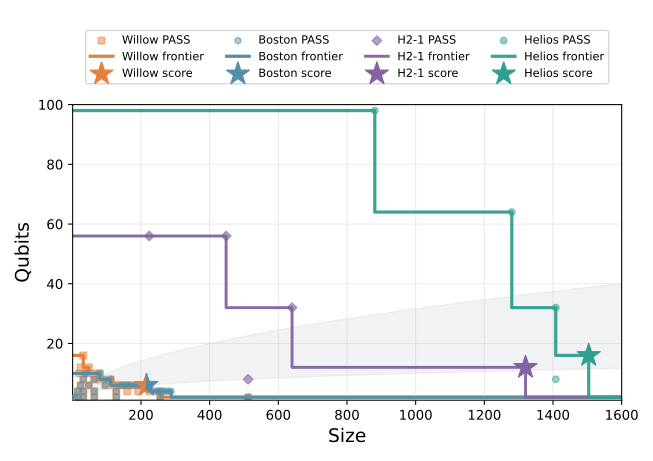
Figure 1. The QUOPS capability region and score for state-of-the-art processors from Quantinuum, Google, and IBM (adapted from Figure 2 of the scientific publication co-authored by Quantinuum, Sandia National Laboratories, and NVIDIA). QUOPS specifies a random circuit construction that can be built for a specified width (number of qubits) and size (number of quantum gates). A set of circuits is run at several width and size points and the average fidelity of those circuits are measured and compared to a predefined threshold. Each labeled point above represents experimental data from QUOPS circuits that passed the threshold with high confidence. The lines are filled capability limits of each machine between the points. The stars indicate the QUOPS score (Q), which is the experimental data point that passes the threshold with maximum size inside the shaded cone of width2 ≤ size ≤ width3.
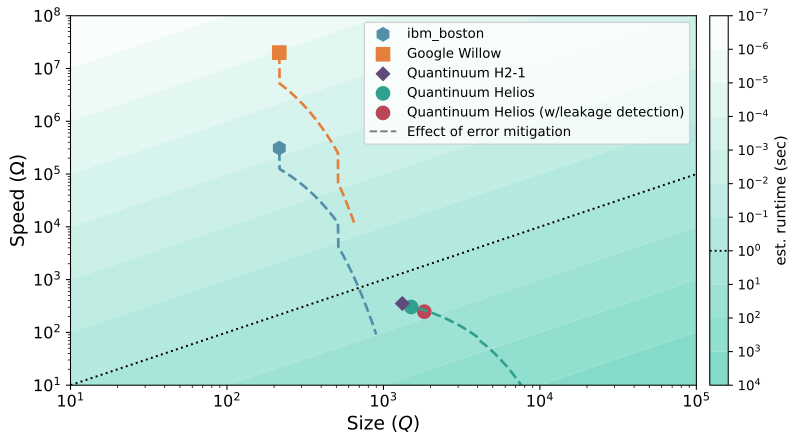
Figure 2. The QUOPS score (Q) vs rate (Ω) for state-of-the-art processors from Quantinuum, Google, and IBM (adapted from Figure 2 of the QUOPS scientific publication co-authored by Quantinuum, Sandia National Laboratories, and NVIDIA). Each point is the maximum QUOPS circuit size that passes the threshold within the specified cone and rate that it was run. The dashed lines indicate the extrapolated effect of error mitigation, which attenuates the rate by including the shot overhead needed for general-purpose error mitigation. The gradient lines show the estimated runtime of a circuit at a given score and rate.
Figures 1 and 2 show how QUOPS quantifies the capability tradeoffs between different systems. Willow and Boston are superconducting systems with very fast gate speeds but limited connectivity, while Helios is a trapped-ion QCCD system with effective all-to-all connectivity but much slower gates. Willow and Boston have smaller capability regions and QUOPS scores but higher QUOPS rates; while Helios reaches larger capability regions and QUOPS scores but lower QUOPS rates. All three systems have the ability to trade speed for larger circuits with error mitigation. This is commonly assumed in the community but is nicely quantified with the QUOPS rate, which accounts for the corresponding sampling overheads of general error mitigation techniques (as shown by the dashed lines in Figure 2).
Building a New Benchmarking Ecosystem
QUOPS will not replace every quantum benchmark. The field will continue to need application-specific suites, component-level measurements, hybrid-HPC benchmarks, and independent verification.
QUOPS instead serves as a common system-level yardstick that can make roadmaps more comparable, procurement more objective, and progress easier to track.
We are calling on vendors to report QUOPS metrics (Q, Ω) and capability regions alongside existing metrics, buyers and agencies to consider QUOPS thresholds in RFPs, and researchers to contribute fault-tolerant architectures and resource estimates.
As quantum computers become fault tolerant, success will no longer be defined simply by how many qubits a machine contains or how low its error rates are.
It will be defined by the computation the machine can deliver.
QUOPS is a step toward measuring that capability—and toward giving the quantum industry a benchmark built for the era ahead.