Quantinuum Reports Third Quarter 2026 Results and Raises Full-Year Revenue Outlook

November 5, 2026
  • Third-Quarter Revenue Grew 233% Year-Over-Year; Raised FY2026 Revenue Outlook
  • Extended Fault-Tolerance Industry Leadership with Back-to-Back World Records, Validating Most Credible Path to Universal, Fault-Tolerant Quantum Computing
  • Announced Nexus Roadmap Through Apollo; Platform Adoption Grew Nearly 20% Quarter-Over-Quarter and Job Submissions Increased Tenfold Year-Over-Year for the 12 Months Ended August 2026
  • Secured Largest Cloud Agreement in Company History, Including Multi-Year Committed Full-Stack Access Through Apollo
  • Expanded Enterprise Reach Through Leading Hyperscaler Agreement and Oracle Beta Launch

Quantinuum Inc. (Nasdaq: QNT) (the “Company”), a leading full-stack quantum computing company, today announced financial results for the third quarter ended September 30, 2026.  
“In the third-quarter, we extended our technology leadership in the critical area of fault-tolerance, added to our customer base, and expanded our routes to market,” said Rajeeb Hazra, President and Chief Executive Officer of Quantinuum. “This accelerated momentum is supporting our raised revenue outlook for 2026 and giving us more confidence than ever in the opportunity in front of us.”

Third Quarter 2026 Financial Highlights

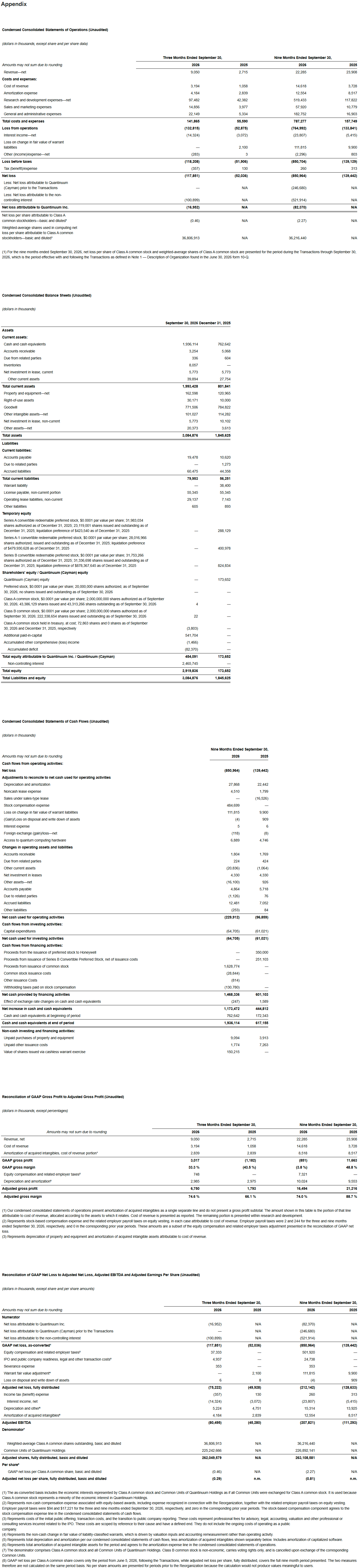
  • Revenue was $9.1 million, an increase of 233% year-over-year, compared with $2.7 million in the prior-year period.  
  • GAAP gross margin was 33.3%, compared with (43.5%) the prior-year period.
  • Adjusted gross margin was 74.6%, up 853 basis points versus the prior-year period.
  • Adjusted EBITDA loss was $80 million, compared with a loss of $45 million in the prior-year period.  
  • GAAP net loss was $118 million, compared with a net loss of $52 million in the prior-year period.
  • GAAP net loss per share attributable to Class A common stockholders was $0.46.  
  • Adjusted net loss per share was $0.29.
  • Cash & cash equivalents were $1.94 billion as of September 30, 2026.  

Adjusted EBITDA, Adjusted Gross Margin and Adjusted net loss per share are non-GAAP financial measures defined under “Non-GAAP Financial Measures.” For a reconciliation of these non-GAAP financial measures to the most directly comparable GAAP financial measures, refer to the Appendix tables at the end of this press release.

Third Quarter and Recent Business Highlights

Commercial Highlights:

  • Signed the largest cloud agreement in Company history, securing a multi-year extension with a leading global financial institution that includes committed access through Apollo and Nexus.
  • Signed with another top 5 global pharmaceuticals company on applying quantum computing and AI to cancer-therapy materials that offer the potential to accelerate drug development and enable more effective treatments.  
  • Signed agreement with GE Vernova to advance application development in superconducting materials.
  • Signed deal with Abu Dhabi Maritime Academy and Quincus for research and applications in maritime logistics.
  • Expanded cloud distribution through a new agreement with a leading hyperscaler serving millions of developers and advanced Oracle partnership by launching a joint beta program for hybrid quantum-AI applications.
  • Deepened U.S. government commitments by continuing to execute on DARPA QBI Stage B contract, actively discussing a Stage C scope of work, and participating in four winning proposals under Phase 1 of the Department of Energy’s Genesis Mission  
  • Advanced international deployments, with Helios assembly underway in Singapore ahead of spring 2027 commissioning and a Reimei system upgrade at RIKEN in Japan scheduled for completion this month.

Product Technology & Supply Chain:

  • Validated the Company’s leading path to universal, fully fault-tolerant quantum computing by 2029 with back-to-back accuracy world records on Helios using two codes within the same scalable, end-to-end logical architecture. Reached 99.9995% logical fidelity in October—within Apollo’s target range—with an error rate ten times lower than September’s record and 100 times lower than the best published result across other hardware modalities. Results also demonstrate Quantinuum’s significant overhead and scalability advantage.
  • Sol remains on track for 2H 2027, with full-scale control-system validation complete and integration and assembly targeted for Q1 2027, ahead of validation and tuning toward 100 logical qubits at a target logical error rate of 10⁻⁵.
  • Apollo remains on track for 2029, supported by design milestones, including validating that our cryogenic system can be deployed at the required scale.
  • Strengthened the manufacturing foundation for future systems through partnerships with GlobalFoundries, Infineon, Honeywell Aerospace and Monarch Quantum, and finalized the CHIPS R&D award as the only trapped-ion company selected.

Software:

  • Announced a multi-generational Nexus roadmap through Apollo, aligning application development and hybrid deployment with successive hardware generations to build what the Company believes will be the first developer platform designed for the fault-tolerant era.
  • Expanded fault-tolerant capabilities through a September Nexus release that extends Guppy tools for logical-qubit programming and supported error-correction encoding, reducing the need to rewrite applications for specific codes. Planned December release will expand responsive hybrid quantum-classical workflows, supported error-correction codes, and execution analytics for application optimization.
  • Accelerated Nexus adoption and usage, with adoption growing nearly 20% quarter-over-quarter to 215 organizations; total job submissions increased tenfold in the 12 months through August 2026 compared with the preceding 12-month period.

Ecosystem:  

  • Introduced QUOPS with Sandia National Laboratories and NVIDIA, benchmarking useful computational scale and speed. Quantinuum is building industry-wide alignment toward a common standard that supports customer comparisons and purchasing decisions.
  • Expanded the quantum user ecosystem, growing Q-Net to more than 800 members, adding eight startup partners and partnering with Singapore’s National Quantum Office to organize a global quantum challenge that attracted more than 200 submissions.

Financial Outlook
  • Raising full-year 2026 revenue outlook to $31 to $34 million, up from $28 to $32 million previously.  

Third Quarter 2026 Conference Call

Quantinuum will host a conference call at 5 PM Eastern time on Thursday, November 5, 2026, to discuss its results for the third quarter ended September 30, 2026, and provide a business update. The call will be available live via webcast here.

An archive replay of the webcast will be made available on the Quantinuum Investor Relations website following the call and will remain available for one year.  

Non-GAAP Financial Measures

To supplement Quantinuum’s condensed consolidated financial statements presented in accordance with U.S. generally accepted accounting principles (“GAAP”), the Company uses the following non-GAAP financial measures presented in this release: Adjusted Gross Profit, Adjusted Gross Margin, Adjusted Net Loss, fully distributed, Adjusted EBITDA, and Adjusted Net Loss Per Share, fully distributed.

Adjusted Gross Profit starts with GAAP gross profit and adds back equity compensation and related employer taxes attributable to cost of revenue and depreciation and amortization attributable to cost of revenue.

Adjusted Gross Margin is calculated as Adjusted Gross Profit divided by revenue, net.

Adjusted Net Loss, fully distributed starts with GAAP net loss on an as-converted basis, adjusts for equity compensation and related employer taxes, costs of the initial public offering and the transition to public company reporting, severance expense, the change in fair value of liability-classified warrants, and loss on disposal and write down of assets, and then applies an assumed statutory tax rate to the resulting adjusted pre-tax loss. No tax benefit is recognized in respect of losses subject to a full valuation allowance, and accordingly no tax benefit is reflected in the periods presented.

Adjusted EBITDA starts with Adjusted Net Loss, fully distributed, and further excludes income tax expense, interest income, net, depreciation, and amortization of acquired intangibles.

Adjusted Net Loss Per Share, fully distributed is calculated as Adjusted Net Loss, fully distributed, divided by adjusted shares, fully distributed, basic and diluted, comprising weighted-average Class A common shares outstanding and Common Units of Quantinuum Holdings.

Management believes these measures provide investors with additional information useful in evaluating the Company’s operating performance and trends across periods. Quantinuum’s results include large non-cash charges that management does not consider indicative of ongoing operating performance, principally stock-based compensation recognized on completion of the Reorganization and remeasurement of liability-classified warrants. Both are driven by accounting triggers and external inputs rather than operating activity. As an early commercial-stage business, Quantinuum’s period-to-period results also are affected by the timing of individual contracts. Measures that isolate underlying operating performance from non-cash and transition items help investors assess trends across periods.

Quantinuum’s Up-C structure means that GAAP net loss attributable to Quantinuum Inc. reflects only the Class A share of the economics. Presenting adjusted results on an as-converted, fully distributed basis describes the whole economic enterprise, which is how management assesses performance and how the business is managed. Management uses these measures for internal planning and forecasting, evaluating operating performance, and preparing budgets.

These non-GAAP financial measures are supplemental and are not prepared in accordance with GAAP. They are not intended to be considered in isolation or as a substitute for the most directly comparable financial information prepared in accordance with GAAP. Quantinuum’s non-GAAP measures may differ from similarly titled measures used by other companies and, therefore, may not be comparable. Investors should review the reconciliations and should not rely on any single financial measure to evaluate the Company’s business.

Each non-GAAP financial measure is reconciled to its most directly comparable GAAP financial measure in the tables at the end of this release.

About Quantinuum

Quantinuum is a leading quantum computing company offering a full-stack platform designed to make quantum computing deployable in real-world environments. The company has commercially deployed multiple generations of trapped-ion based quantum systems built on the well-established QCCD architecture, which it has implemented with novel designs and capabilities to achieve the industry’s highest accuracy levels based on average two-qubit gate fidelity. Quantinuum has active engagements with market leaders across pharmaceuticals, material science, financial services, and government and industrial markets, as well as academic and research institutions globally.

The company has a global workforce of approximately over 850 employees, including top scientists and researchers. Over 70% of its technology team holds PhDs or Master’s degrees. Quantinuum’s headquarters is in Broomfield, Colorado, with additional facilities across the United States, United Kingdom, Germany, Japan, Qatar, and Singapore.

Availability of Information on Quantinuum’s Website

Investors and others should note that Quantinuum routinely announces material information to investors and the marketplace using SEC filings, press releases, public conference calls, webcasts, and the Quantinuum Investor Relations website. While not all of the information that the Company posts to the Quantinuum Investor Relations website is of a material nature, some information could be deemed to be material. Accordingly, the Company encourages investors, the media, and others interested in Quantinuum to review the information that it shares on ir.quantinuum.com.

Forward-Looking Statements

This press release contains forward-looking statements within the meaning of the Private Securities Litigation Reform Act of 1995. These statements are based on the current beliefs and expectations of Quantinuum’s management and are subject to significant risks and uncertainties. Actual results may differ materially from those described in the forward-looking statements. Any statements made in this press release that are not statements of historical fact, including statements about our beliefs, expectations and outlook are forward-looking statements. Forward-looking statements include information concerning possible or assumed future results of operations, including our guidance and descriptions of our business plans and strategies. These statements often include words such as “anticipate,” “expect,” “guidance,” “suggest,” “plan,” “believe,” “intend,” “estimate,” “target,” “project,” “should,” “could,” “would,” “may,” “will,” “forecast,” “outlook,” “potential,” “continues,” “seeks,” “predicts,” or the negatives of these words and other similar expressions.

Factors that could cause actual results to differ materially from those described in forward-looking statements include, but are not limited to: our ability to develop, commercialize and achieve market acceptance of our quantum computing hardware and software products; the pace of development of the quantum computing industry and the timing of commercial quantum advantage; our ability to attract and retain customers for our quantum computing systems and quantum computing as a service offerings; the risk of technological obsolescence or the emergence of competing quantum computing approaches, including superconducting, photonic, or other modalities; our dependence on key suppliers and manufacturers of specialized components, including those necessary for our trapped-ion quantum systems; our ability to scale production of our quantum computers and related systems; our ability to protect our intellectual property and proprietary technology; the significant research and development costs inherent in developing next-generation quantum computing capabilities; our ability to attract and retain highly skilled scientists, engineers and other personnel in a competitive labor market; changes in government funding, export controls, or regulations affecting quantum technologies; uncertainty regarding the timing and extent of commercial applications; cybersecurity risks and the protection of sensitive customer data; and macroeconomic conditions, geopolitical instability and their potential effects on our business and operations. For additional information on these and other risks that could affect the Company's forward-looking statements, see the Company's risk factors discussed in its filings with the U.S. Securities and Exchange Commission, including its most recent Quarterly Report on Form 10-Q, as such risk factors may be updated from time to time. You should evaluate all forward-looking statements made in this press release in the context of these risks and uncertainties. The Company disclaims any intent or obligation to update, revise or withdraw any forward-looking statement in this press release, except as required by applicable law or regulation.

Contacts

Investor & Media Contact

Shub Mukherjee - Investor Contact - investors@quantinuum.com

Aaron Sorenson - Media Contact - press@quantinuum.com
‍

About Quantinuum

Quantinuum, the world’s largest integrated quantum company, pioneers powerful quantum computers and advanced software solutions. Quantinuum’s technology drives breakthroughs in materials discovery, cybersecurity, and next-gen quantum AI. With over 500 employees, including 370+ scientists and engineers, Quantinuum leads the quantum computing revolution across continents. 

November 5, 2026
Quantinuum Unveils Nexus Roadmap to Deliver the First Developer Platform Designed for the Fault-Tolerant Quantum Era
  • Roadmap connects application development and deployment with each generation of Quantinuum hardware through Apollo, its universal, fault-tolerant quantum computer planned for 2029.
  • Nexus is designed to be the first developer platform that integrates automated error-correction encoding, execution on Quantinuum hardware, and hybrid workflow orchestration.
  • Nexus will progressively handle the complexity of fault-tolerant application development and deploy programs that can scale and grow in capability as hardware advances.

BROOMFIELD, Colo. – November 5, 2026 – Quantinuum (NASDAQ: QNT), the leading full-stack quantum computing company, today unveiled a new roadmap to evolve Quantinuum Nexus, its platform as a service, with the aim of delivering the quantum industry’s first developer platform designed for the fault-tolerant era. The roadmap introduces new capabilities with each generation of hardware through Apollo—the company’s first universal, fully fault-tolerant quantum computer planned for 2029—that further simplify and automate how customers build, deploy, and operate quantum applications.

Since its launch in 2024, Nexus has expanded from managing cloud-based quantum workflows to end-to-end application development and deployment, bringing programming, validation, compilation, and execution into one environment. Nexus provides managed access to the software tools and computing resources customers need for hybrid applications and workflows. Nexus offers flexible access and integration options, both in the cloud and on-premises.

Through 2029, successive releases aim to progressively automate and simplify error correction, resource management, orchestration, and deployment, enabling developers to build and integrate increasingly capable applications at the logical level.

By developing its quantum hardware and software together, Quantinuum helps improve application performance across the entire system and turn hardware advances into capabilities customers can use. Nexus is designed to align those capabilities with each hardware generation, giving customers a simpler development path and Quantinuum a stronger platform for winning and expanding user adoption. Developers can already automatically apply supported error-correction techniques to programs and run them on Helios.

Today, Nexus already supports more than 200 organizations, up 45% in 2026, while total job submissions increased tenfold in the 12 months through August 2026 compared with the preceding 12-month period. This growing engagement establishes a customer and developer base that Quantinuum can continue to grow as its hardware matures.

“Our full-stack approach means each advance in hardware can become a capability customers can build on through Nexus,” said Dr. Rajeeb Hazra, Quantinuum CEO. “Our aim is to build the first developer platform specifically for the fault-tolerant era so customers can start developing applications today and carry that investment forward. Nexus is designed to help them deploy applications and hybrid workflows and integrate the platform into their computing environments. As our systems become more capable, our aim is for the applications, workflows, and expertise customers develop in Nexus to become more valuable, giving them a compelling reason to build with Quantinuum and making Nexus an enduring part of their computing environment.”

Building a Developer Platform for the Fault-Tolerant Era

The Nexus roadmap organizes its capabilities around three stages of the application lifecycle—develop, optimize, and deploy—helping customers build hybrid quantum-classical applications that can advance with successive generations of Quantinuum hardware:

  • Develop: The roadmap includes pre-built primitives, fault-tolerant libraries, and domain-specific tools that help developers move from individual quantum circuits to complete applications. The platform will progressively automate error-correction encoding, compilation, and resource management, allowing developers to focus more on the application and less on the underlying hardware complexity.
  • Optimize: The roadmap outlines tools to analyze runtime behavior, resource requirements, and application performance. Future releases plan to introduce more error suppression, real-time diagnostics, and increasingly automated error recovery to help customers run larger computations and make more efficient use of quantum resources.
  • Deploy: Nexus is being designed to coordinate quantum and classical computing across Quantinuum processors, high-performance computing systems, cloud infrastructure, and third-party tools—helping customers integrate quantum workflows into their existing computing environments and deploy larger fault-tolerant applications.

“Quantum computers are on the brink of achieving fault tolerance at scale. It's exciting: we are entering terra incognita for what we can compute. The new challenge is putting our high-level quantum algorithms into the right form to successfully run on error-corrected hardware. Developer platforms like Nexus help us bridge that gap between quantum algorithm design and deployment,” said José Ignacio Latorre, Director of the Centre for Quantum Technologies, Singapore’s flagship national research center for quantum technology.

Optimized specifically for Quantinuum systems, these capabilities are expected to provide a continuous path from early application development on Helios to increasingly capable implementations on Sol and Apollo to help customers carry their investments forward as the hardware advances.

Building the Foundation Today

Quantinuum is already delivering key elements of this approach. Released in September 2026, Guppy FT and Guppy Algorithms expanded Nexus with supported error-correction schemes, fault-tolerant operations, and composable algorithmic building blocks.

Developers can write programs, automatically encode them for supported error-correction schemes, test them in emulation, and execute supported programs on Helios. Advanced users retain the flexibility to customize architectures for specialized applications.

These capabilities establish the foundation for future roadmap releases, including the upcoming December release which is expected to expand hybrid workflows so that applications can respond to quantum results as they become available. It is also expected to add supported error-correction codes and execution analytics to help developers optimize performance.

Connecting Quantum Applications with Enterprise Computing

Researchers and enterprises are already using Nexus to develop applications across chemistry, materials science, life sciences, and AI, while also integrating Nexus into new environments:

  • Qubit Pharmaceuticals and CQT used Nexus to execute quantum Monte Carlo experiments on Quantinuum’s System Model H2 and Helios systems.
  • Researchers at RIKEN and the University of Tokyo simulated atomic nuclei on Reimei, using Nexus. They also used Nexus to integrate hybrid quantum-HPC workflows to calculate excited-state energies in a model biomolecular system.
  • University of Cambridge researchers used Nexus compilation tools to prepare efficient quantum chemistry circuits while Maastricht University researchers used Nexus to simulate, compile, and run a quantum particle tracking algorithm exploring new approaches to reconstructing particle trajectories.
  • Unitary Foundation’s Metriq gym uses Nexus to access Quantinuum hardware for reproducible benchmarking across quantum computing platforms.
  • Quantinuum is integrating Nexus into Oracle Cloud Infrastructure’s environment to help support the on-prem deployment and integration of Quantinuum’s Helios computer into OCI’s cloud services offering.

Explore the full Nexus roadmap here. Click here to register for access to the Nexus cloud platform.

About Quantinuum

Quantinuum is a leading quantum computing company offering a full-stack platform designed to make quantum computing deployable in real-world environments. The company has commercially deployed multiple generations of trapped-ion based quantum systems built on the well-established QCCD architecture, which it has implemented with novel designs and capabilities to achieve the industry’s highest accuracy levels based on average two-qubit gate fidelity. Quantinuum has active engagements with market leaders across pharmaceuticals, material science, financial services, and government and industrial markets, as well as academic and research institutions globally. The company has a global workforce of approximately 800 employees, including top scientists and researchers. Over 70% of its technology team holds PhDs or Master’s degrees. Quantinuum’s headquarters is in Broomfield, Colorado, with additional facilities across the United States, United Kingdom, Germany, Japan, Qatar, and Singapore. For more information, please visit www.quantinuum.com.

Forward-Looking Statements

This press release contains forward-looking statements within the meaning of Section 27A of the Securities Act of 1933, as amended, and Section 21E of the Securities Exchange Act of 1934, as amended, which are intended to be covered by the safe harbor provisions of the Private Securities Litigation Reform Act of 1995. All statements other than statements of historical fact are forward-looking statements, including statements about the Quantinuum Nexus roadmap and the expected features, capabilities, benefits and timing of future Nexus releases, including the expected development, capabilities and timing of Quantinuum’s hardware, including Sol and Apollo, and the planned availability of Apollo in 2029; the expected adoption and use of Nexus by customers and developers and Quantinuum’s ability to expand that adoption into broader commercial use; the integration of Nexus with Oracle Cloud Infrasturture and other third-party computing environments; and the potential of fault-tolerant quantum computing. . Words such as "aim," "anticipate," "believe," "could," "expect," "explore," "intend," "may," "plan," "potential," "seek," "will," "would" and similar expressions identify forward-looking statements, although not all forward-looking statements contain these words.

Forward-looking statements are based on Quantinuum's current expectations and assumptions and are subject to risks and uncertainties that could cause actual results to differ materially from those expressed or implied. These risks include, among others: delays or difficulties in developing, teting or releasing new Nexus capabilities or Quantinuum hardware, including Sol and Apollo, on the expected timelines or at all; the possibility that error-correction techniques do not perform as expected at scale; the pace of technical progress in quantum computing; Quantinuum's ability to maintain the availability and performance of its systems, including Helios; the level of customer and developer adoption and continued use of Nexus; Quantinuum’s reliance on third parties, including cloud and high-performance computing providers; competition; the availability of funding, personnel and government support; and the other risks described under "Risk Factors" in Quantinuum's Quarterly Report on Form 10-Q for the quarter ended June 30, 2026 and its subsequent filings with the Securities and Exchange Commission. Forward-looking statements speak only as of the date of this press release. Quantinuum undertakes no obligation to update any forward-looking statement, except as required by law.

This is some text inside of a div block.
All
This is some text inside of a div block.
All
This is some text inside of a div block.
All
October 22, 2026
Quantinuum to Report Third Quarter Financial Results on November 5, 2026

BROOMFIELD, Colo., October 22, 2026 /PRNewswire/ -- Quantinuum Inc. (Nasdaq: QNT) ("Quantinuum") today announced it will release its financial results for the third quarter ended September 30, 2026, on November 5, 2026, after market close.

Quantinuum will host a conference call at 5:00 PM Eastern time that same day to discuss its financial results. The call will be available through a live webcast available here.

An archive replay of the webcast will be made available on the Quantinuum Investor Relations website following the call and will remain available for one year.

About Quantinuum

Quantinuum is a leading quantum computing company offering a full-stack platform designed to make quantum computing deployable in real-world environments. The company has commercially deployed multiple generations of quantum systems built on the well-established QCCD architecture, which it has implemented with novel designs and capabilities to achieve the industry's highest accuracy levels based on average two-qubit gate fidelity as of December 31, 2025. Quantinuum has active engagements with market leaders across pharmaceuticals, material science, financial services, and government and industrial markets. Quantinuum's headquarters is in Broomfield, Colorado, with additional facilities across the United States, United Kingdom, Germany, Japan, Qatar and Singapore.

Media & Investor Contact

Longacre Square Partners

investors@quantinuum.com

This is some text inside of a div block.
All
This is some text inside of a div block.
All
This is some text inside of a div block.
All
October 19, 2026
Quantinuum Breaks Error-Correction World Record by 10x, Validating its Leading Path to Fault-Tolerant Quantum Computing by 2029
  • Quantinuum’s Helios computer achieves a world-record 99.9995% logical fidelity—just five errors in a million operations—using the company’s error-correction architecture.
  • Error rate is 10x lower than Quantinuum’s own September 2026 record and 100x lower than the best published result across all other hardware modalities, which was reported by Google Quantum AI using a superconducting system.
  • Quantinuum’s successive breakthroughs used different codes on the same hardware, demonstrating how its error-correction architecture and trapped-ion technology drive rapid gains in accuracy, with performance now in the target range for Apollo.

BROOMFIELD, Colo.—October 19, 2026—Quantinuum (NASDAQ: QNT), a leading full-stack quantum computing company, today announced a world-record quantum error-correction result, achieving a logical fidelity of 99.9995% on its Helios commercial computer using the company’s error-correction architecture. This marks Quantinuum’s second breakthrough in two months, demonstrating how its highly accurate trapped-ion hardware and flexible architecture work together to deliver rapid improvements in accuracy.

The achievement reinforces Quantinuum’s error-correction leadership and validates that its accuracy performance is now within the target range for Apollo, the company's planned universal fault-tolerant quantum computer expected to be available by 2029.

Quantinuum’s architecture is an end-to-end framework programmable through the company’s developer platform. It integrates tailored AI decoders, all-to-all qubit connectivity, high-fidelity physical operations, and hardware-level error correction. This architecture also allows the company to test, refine, and combine different error-correction codes and optimize between accuracy and efficiency.

In the latest study, Quantinuum used a well-known “color code” within this architecture to achieve the world-record logical fidelity result, which is equivalent to just five errors per million operations. The error rate is 10 times lower than Quantinuum’s own world record achieved last month and 100 times lower than the best published result across all other hardware modalities, which was reported by Google Quantum AI on a superconducting system.

“With this result, we’ve proven that we have the error-correction architecture and trapped-ion technology required to achieve universal fault-tolerance,” said Dr. Rajeeb Hazra, CEO of Quantinuum. “We have reduced error rates tenfold in rapid succession using a different code on the same commercial hardware, demonstrating the flexibility of our error-correction architecture. We’ve crossed the threshold necessary for exponential improvements in accuracy, reinforcing our path to Apollo and how we can help users unlock commercial value from quantum at scale.”

The study also showed that logical errors fell exponentially as Quantinuum increased the “code distance,” a technique used to understand how many physical qubits are needed to protect quantum information as the error correction scales. Each tested increase reduced the remaining logical errors by a record factor of 12, demonstrating increasingly effective error suppression as the code grows—a critical capability for scaling fault-tolerant quantum computing. Quantinuum believes this result suggests it can deliver fault-tolerance with significantly fewer qubits than are required for other modalities.

“This is a significant milestone that quantum computing researchers have been working toward for many years,” said Robin Blume-Kohout, co-director of Sandia National Laboratories’ Quantum Performance Lab, who was not involved in the study. “The paper demonstrates real, serious performance gains from quantum error correction—a logical qubit nearly 100x better than its component physical qubits. A scaled-up version of this system could reach the reliability required for useful fault-tolerant computation at a feasible size—less than a million physical qubits—which improves the outlook for practical quantum computing. These findings go a long way to retire one of the field’s central technical risks.”

In September 2026, Quantinuum used the same error-correction architecture with its Helix code to demonstrate record-setting logical memory and computation. Both studies ran on the same Helios hardware.

The two demonstrations illustrate how Quantinuum can rapidly prototype different error-correction codes within the same architecture to optimize for relative strengths in accuracy, efficiency, and speed. On Helios, Helix used 10 physical qubits per logical qubit, compared with up to 37 for the color code, while the color code delivered lower logical error rates. This provides insight into which applications pair best with each code as systems advance toward fault-tolerance.

Quantinuum’s error-correction architecture is flexible, allowing for adaptive syndrome extraction, which adjusts error-checking measurements during computation, and chain-mapping, which connects codes suited to different computational tasks. Together with efficient code structures and real-time decoding, these techniques provide multiple ways to reduce errors and resource requirements.

Quantinuum is combining its hardware, error-correction architecture, and full-stack software platform into an integrated system for fault-tolerant quantum computing. As customers prepare for this next era of computing, Quantinuum is providing the tools needed to develop and scale quantum applications capable of addressing challenges across materials science, chemistry, finance, logistics, and other critical sectors.

Read the full research here: quantinuum.com/fault-tolerance-by-2029‍

About Quantinuum

Quantinuum is a leading quantum computing company offering a full-stack platform designed to make quantum computing deployable in real-world environments. The company has commercially deployed multiple generations of trapped-ion based quantum systems built on the well-established QCCD architecture, which it has implemented with novel designs and capabilities to achieve the industry’s highest accuracy levels based on average two-qubit gate fidelity. Quantinuum has active engagements with market leaders across pharmaceuticals, material science, financial services, and government and industrial markets, as well as academic and research institutions globally. The company has a global workforce of approximately 800 employees, including top scientists and researchers. Over 70% of its technology team holds PhDs or Master’s degrees. Quantinuum’s headquarters is in Broomfield, Colorado, with additional facilities across the United States, United Kingdom, Germany, Japan, Qatar, and Singapore. For more information, please visit www.quantinuum.com.

Forward-Looking Statements

This press release contains forward-looking statements within the meaning of Section 27A of the Securities Act of 1933, as amended, and Section 21E of the Securities Exchange Act of 1934, as amended, which are intended to be covered by the safe harbor provisions of the Private Securities Litigation Reform Act of 1995. All statements other than statements of historical fact are forward-looking statements, including statements about Quantinuum’s path to and the expected timing of Apollo, its planned universal fault-tolerant quantum computer, by 2029; the expected performance, scalability and resource requirements of Quantinuum’s logical error-correction architecture, error-correction codes and trapped-ion hardware, including the number of physical qubits required to achieve fault tolerance relative to other approaches; the pace of future improvements in logical error rates, Quantinuum’s ability to help customers prepare for and realize commercial value from fault-tolerant quantum computing; and the potential impact of quantum computing on sectors including materials science, chemistry, finance and logistics. Words such as "aim," "anticipate," "believe," "confidence,” "could," "expect," "explore," "intend," "may," “path,” "plan," "potential," "seek," “suggest,” "will," "would" and similar expressions identify forward-looking statements, although not all forward-looking statements contain these words.

Forward-looking statements are based on Quantinuum's current expectations and assumptions and are subject to risks and uncertainties that could cause actual results to differ materially from those expressed or implied. These risks include, among others: the results described in this press release were achieved in experimental settings and  may not be able to be replicated at a larger scale, in logical computation, or in commercial use; Quantinuum may be unable to scale its systems, increase qubit counts or integrate its hardware, error-correction framework and software as planned; Quantinuum may not achieve its technology roadmap, including Apollo, on the expected timeline or at all; the pace of technical progress in quantum computing; Quantinuum's ability to maintain the availability and performance of its systems, including Helios; competition, including advances by companies using other quantum computing modalities or architectures; the availability of funding, personnel and government support; and the other risks described under "Risk Factors" in Quantinuum's Quarterly Report on Form 10-Q for the quarter ended June 30, 2026 and its subsequent filings with the Securities and Exchange Commission. Forward-looking statements speak only as of the date of this press release. Quantinuum undertakes no obligation to update any forward-looking statement, except as required by law.

This is some text inside of a div block.
All
This is some text inside of a div block.
All
This is some text inside of a div block.
All