

Quantum gravity in the lab
In the world of physics, ideas can lie dormant for decades before revealing their true power. What begins as a quiet paper in an academic journal can eventually reshape our understanding of the universe itself.
In 1993, nestled deep in the halls of Yale University, physicist Subir Sachdev and his graduate student Jinwu Ye stumbled upon such an idea. Their work, originally aimed at unraveling the mysteries of “spin fluids”, would go on to ignite one of the most surprising and profound connections in modern physics—a bridge between the strange behavior of quantum materials and the warped spacetime of black holes.
Two decades after the paper was published, it would be pulled into the orbit of a radically different domain: quantum gravity. Thanks to work by renowned physicist Alexei Kitaev in 2015, the model found new life as a testing ground for the mind-bending theory of holography—the idea that the universe we live in might be a projection, from a lower-dimensional reality.
Holography is an exotic approach to understanding reality where scientists use holograms to describe higher dimensional systems in one less dimension. So, if our world is 3+1 dimensional (3 spatial directions plus time), there exists a 2+1, or 3-dimensional description of it. In the words of Leonard Susskind, a pioneer in quantum holography, "the three-dimensional world of ordinary experience—the universe filled with galaxies, stars, planets, houses, boulders, and people—is a hologram, an image of reality coded on a distant two-dimensional surface."
The “SYK” model, as it is known today, is now considered a quintessential framework for studying strongly correlated quantum phenomena, which occur in everything from superconductors to strange metals—and even in black holes. In fact, The SYK model has also been used to study one of physics’ true final frontiers, quantum gravity, with the authors of the paper calling it “a paradigmatic model for quantum gravity in the lab.”
The SYK model involves Majorana fermions, a type of particle that is its own antiparticle. A key feature of the model is that these fermions are all-to-all connected, leading to strong correlations. This connectivity makes the model particularly challenging to simulate on classical computers, where such correlations are difficult to capture. Our quantum computers, however, natively support all-to-all connectivity making them a natural fit for studying the SYK model.
Now, 10 years after Kitaev’s watershed lectures, we’ve made new progress in studying the SYK model. In a new paper, we’ve completed the largest ever SYK study on a quantum computer. By exploiting our system’s native high fidelity and all-to-all connectivity, as well as our scientific team’s deep expertise across many disciplines, we were able to study the SYK model at a scale three times larger than the previous best experimental attempt.
While this work does not exceed classical techniques, it is very close to the classical state-of-the-art. The biggest ever classical study was done on 64 fermions, while our recent result, run on our smallest processor (System Model H1), included 24 fermions. Modelling 24 fermions costs us only 12 qubits (plus one ancilla) making it clear that we can quickly scale these studies: our System Model H2 supports 56 qubits (or ~100 fermions), and Helios, which is coming online this year, will have over 90 qubits (or ~180 fermions).
However, working with the SYK model takes more than just qubits. The SYK model has a complex Hamiltonian that is difficult to work with when encoded on a computer—quantum or classical. Studying the real-time dynamics of the SYK model means first representing the initial state on the qubits, then evolving it properly in time according to an intricate set of rules that determine the outcome. This means deep circuits (many circuit operations), which demand very high fidelity, or else an error will occur before the computation finishes.
Our cross-disciplinary team worked to ensure that we could pull off such a large simulation on a relatively small quantum processor, laying the groundwork for quantum advantage in this field.
First, the team adopted a randomized quantum algorithm called TETRIS to run the simulation. By using random sampling, among other methods, the TETRIS algorithm allows one to compute the time evolution of a system without the pernicious discretization errors or sizable overheads that plague other approaches. TETRIS is particularly suited to simulating the SYK model because with a high level of disorder in the material, simulating the SYK Hamiltonian means averaging over many random Hamiltonians. With TETRIS, one generates random circuits to compute evolution (even with a deterministic Hamiltonian). Therefore, when applying TETRIS on SYK, for every shot one can just generate a random instance of the Hamiltonain, and generate a random circuit on TETRIS at the same time. This simple approach enables less gate counts required per shot, meaning users can run more shots, naturally mitigating noise.
In addition, the team “sparsified” the SYK model, which means “pruning” the fermion interactions to reduce the complexity while still maintaining its crucial features. By combining sparsification and the TETRIS algorithm, the team was able to significantly reduce the circuit complexity, allowing it to be run on our machine with high fidelity.
They didn’t stop there. The team also proposed two new noise mitigation techniques, ensuring that they could run circuits deep enough without devolving entirely into noise. The two techniques both worked quite well, and the team was able to show that their algorithm, combined with the noise mitigation, performed significantly better and delivered more accurate results. The perfect agreement between the circuit results and the true theoretical results is a remarkable feat coming from a co-design effort between algorithms and hardware.
As we scale to larger systems, we come closer than ever to realizing quantum gravity in the lab, and thus, answering some of science’s biggest questions.
About Quantinuum
Quantinuum, the world’s largest integrated quantum company, pioneers powerful quantum computers and advanced software solutions. Quantinuum’s technology drives breakthroughs in materials discovery, cybersecurity, and next-gen quantum AI. With over 500 employees, including 370+ scientists and engineers, Quantinuum leads the quantum computing revolution across continents.
For enterprise and public sector executives evaluating quantum computing investment
Quantum computing is now a strategic priority for many organizations. It's on track to help solve some of the world's biggest challenges, from drug discovery, to materials science, to optimization problems – all at a scale classical computers simply can't reach. For executives responsible for R&D, technology strategy, or innovation investment, the question is no longer whether quantum computing matters. It's how to approach it wisely.
That's a harder question than it sounds. The quantum computing market is crowded, technical, and moving fast, and most of the guidance available is written for physicists, not for the executives who actually have to make the investment decision. Vendor claims are difficult to compare, pilot programs are easy to get wrong, and the gap between "quantum is exciting" and "quantum is worth investing in this year" isn't always well explained.
Our new guide, A Strategic Guide to Selecting the Right Quantum Computing Solution, is built to close that gap.
What's Inside
The guide is designed to give business and technology leaders a clear, practical path through four essential questions:
- Why quantum computing matters now, and why the window for early strategic advantage is open today
- How to evaluate vendors objectively, using a structured framework rather than marketing claims
- How to design an effective pilot, so early investment produces real, usable evidence
- How to take your first steps with confidence, whether you're just starting to explore or ready to scale
It also includes a glossary of key terms, so readers new to the field aren't left decoding jargon before they can evaluate a single vendor.
Who Should Read It
The guide is written for CTOs, CIOs, CISOs, R&D leaders, and program directors across enterprise and public sector organizations, at any stage of quantum familiarity. Whether your organization hasn't yet started exploring quantum computing, or you already have a program underway and are looking to sharpen your evaluation process, the framework inside is designed to apply.
How to Use It
The evaluation framework at the core of the guide isn't specific to any one vendor; it's designed to be applied to any quantum computing solution you're considering, so you can make an apples-to-apples comparison based on your organization's actual needs. The guide also walks through how Quantinuum maps to that same framework, and what it looks like to work with Quantinuum as a co-development partner, should you want a concrete reference point alongside the general framework.
Start With Confidence, Not Guesswork
Quantum computing is a strategic decision, not just a technical one. The organizations that approach it with a clear framework, rather than reacting to the noise, will be the ones positioned to capture real value as the technology matures.
- QUOPS is a new, architecture-agnostic benchmark designed to measure quantum performance across physical- and logical-qubit systems, using two metrics: Q (computation size) and Ω (operations per second).
- It addresses the limits of traditional metrics like qubit count, gate fidelity, and gate speed by measuring what a quantum system can actually execute successfully—including the effects of error correction, decoding, mitigation, compilation, and other system-level factors.
- QUOPS aims to create a common language for the industry, helping vendors demonstrate progress, enabling buyers and governments to make more objective procurement decisions, and giving researchers a standardized way to track progress toward utility-scale, fault-tolerant quantum computing.
Quantum computing is entering a new era. As systems move from Noisy Intermediate-Scale Quantum (NISQ) toward Fault-Tolerant Application-Scale Quantum (FASQ), traditional metrics like qubit count, gate fidelity, and gate speed are no longer enough to describe what a machine can actually deliver.
Introducing QUOPS
Developed by Sandia National Laboratories, with input from Quantinuum and NVIDIA, QUOPS—the Quantum Universal Operations Performance System—is a common, architecture-agnostic benchmark for measuring quantum performance across both physical- and logical-qubit systems on the path toward quantum utility.
QUOPS can be applied to different architectures, codes, modalities, and levels of fault tolerance. QUOPS runs the same randomized workloads across different computational shapes, measures whether each workload succeeds, identifies the boundary of a system’s capability region, and reports two summary metrics:
- Q: the largest benchmark circuit size that passes the success threshold inside a utility-motivated region. Size is defined as 2*(width)*(depth).
- Ω: the effective operations per second at that point.
The result is a direct measure of how much computation a system can perform and how quickly it can do so. Together, these measurements provide a two-dimensional view of capability while reducing system performance to a common currency: quantum operations.
Why Quantum Computing Needs a New Metric
Component-level metrics remain essential for engineering. Qubit count, two-qubit fidelity, and gate speed can reveal control errors, crosstalk, leakage, connectivity constraints, and other system limitations. But they do not necessarily predict system-level performance.
Fault tolerance makes this gap even larger. Physical operations become logical computation with the addition of logical encoding, syndrome measurement, decoding, logical gate construction, magic-state production, routing, and control. Ultimately, this means that fault tolerance expands the relevant currencies of computation. Code distance, logical fidelity, magic-state throughput, decoding, connectivity, and space-time volume can matter far more for performance than raw qubit count or individual gate speeds.
This creates a growing challenge for buyers, governments, and researchers. As organizations move from experimentation toward larger-scale and potentially on-premise quantum systems, they need to know a simple thing:
What computation can a machine actually execute successfully?
QUOPS addresses that question by measuring the integrated system rather than inferring performance from individual components.
This is particularly important as the field considers workloads requiring roughly 10⁹–10¹² operations on thousands of qubits. Today's measured capabilities are still orders of magnitude smaller; QUOPS turns that gap into a measurable quantity.
QUOPS for Procurement
QUOPS can also provide a practical layer for quantum procurement and planning.
HPC centers need to understand when quantum computing will become useful for real workloads. Customers may have a goal of procuring a system that can, for example, run a trillion error-free operations. Today, answering these questions can require complex resource estimates that depend on hardware modality, QEC code, magic-state factories, decoding, compilation, and other architectural choices.
In both cases, QUOPS provides a simpler system-level reference point: Q describes the size of computation a machine can execute, while Ω describes its effective throughput. Furthermore, because QUOPS is architecture-neutral and includes anti-gaming provisions, it can also help buyers compare competing systems without relying solely on vendor-selected metrics or announcements.
How Quantinuum stacks up
While QUOPS is a new benchmark, it has already been measured on several vendors’ hardware. This marks an important step for our industry: we can now compare vendors directly, assessing their capabilities in a way that flattens the differences introduced by modality and architecture choices.
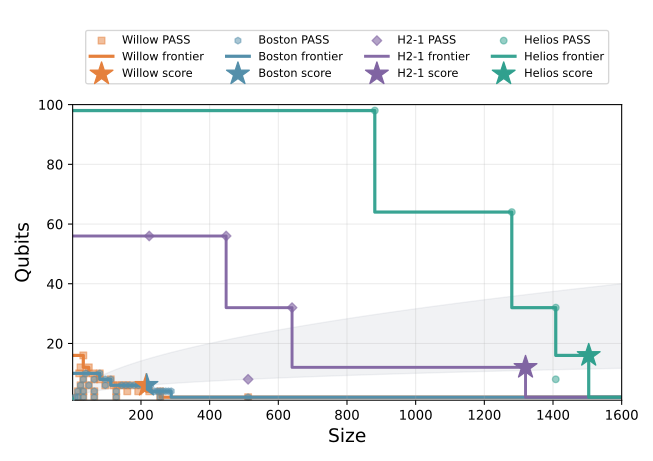
Figure 1. The QUOPS capability region and score for state-of-the-art processors from Quantinuum, Google, and IBM (adapted from Figure 2 of the scientific publication co-authored by Quantinuum, Sandia National Laboratories, and NVIDIA). QUOPS specifies a random circuit construction that can be built for a specified width (number of qubits) and size (number of quantum gates). A set of circuits is run at several width and size points and the average fidelity of those circuits are measured and compared to a predefined threshold. Each labeled point above represents experimental data from QUOPS circuits that passed the threshold with high confidence. The lines are filled capability limits of each machine between the points. The stars indicate the QUOPS score (Q), which is the experimental data point that passes the threshold with maximum size inside the shaded cone of width2 ≤ size ≤ width3.
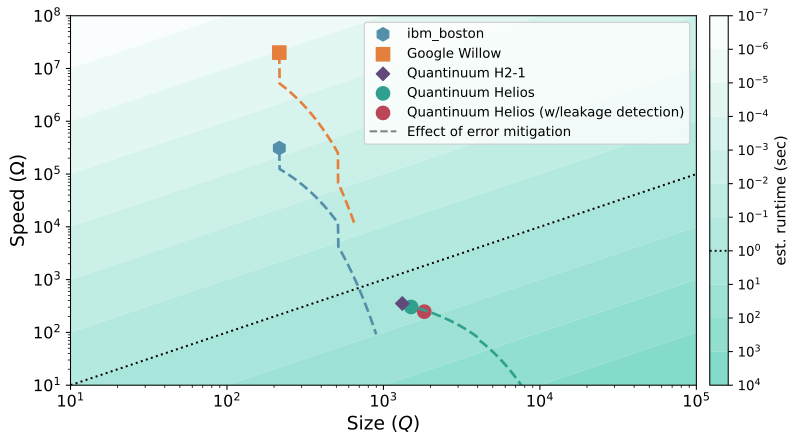
Figure 2. The QUOPS score (Q) vs rate (Ω) for state-of-the-art processors from Quantinuum, Google, and IBM (adapted from Figure 2 of the QUOPS scientific publication co-authored by Quantinuum, Sandia National Laboratories, and NVIDIA). Each point is the maximum QUOPS circuit size that passes the threshold within the specified cone and rate that it was run. The dashed lines indicate the extrapolated effect of error mitigation, which attenuates the rate by including the shot overhead needed for general-purpose error mitigation. The gradient lines show the estimated runtime of a circuit at a given score and rate.
Figures 1 and 2 show how QUOPS quantifies the capability tradeoffs between different systems. Willow and Boston are superconducting systems with very fast gate speeds but limited connectivity, while Helios is a trapped-ion QCCD system with effective all-to-all connectivity but much slower gates. Willow and Boston have smaller capability regions and QUOPS scores but higher QUOPS rates; while Helios reaches larger capability regions and QUOPS scores but lower QUOPS rates. All three systems have the ability to trade speed for larger circuits with error mitigation. This is commonly assumed in the community but is nicely quantified with the QUOPS rate, which accounts for the corresponding sampling overheads of general error mitigation techniques (as shown by the dashed lines in Figure 2).
Building a New Benchmarking Ecosystem
QUOPS will not replace every quantum benchmark. The field will continue to need application-specific suites, component-level measurements, hybrid-HPC benchmarks, and independent verification.
QUOPS instead serves as a common system-level yardstick that can make roadmaps more comparable, procurement more objective, and progress easier to track.
We are calling on vendors to report QUOPS metrics (Q, Ω) and capability regions alongside existing metrics, buyers and agencies to consider QUOPS thresholds in RFPs, and researchers to contribute fault-tolerant architectures and resource estimates.
As quantum computers become fault tolerant, success will no longer be defined simply by how many qubits a machine contains or how low its error rates are.
It will be defined by the computation the machine can deliver.
QUOPS is a step toward measuring that capability—and toward giving the quantum industry a benchmark built for the era ahead.
- A new experiment tests what makes a quantum computer genuinely quantum by using a simple game that demonstrates a provable advantage from quantum superposition, without relying on entanglement or assumptions about classical computational difficulty.
- The test was demonstrated on Quantinuum’s System Model H2, where researchers ran thousands of circuits and observed results close to theoretical quantum predictions. The approach also offers an efficiently verifiable way to test for non-classical behavior.
- The work provides a new way to think about quantum-computing verification: rather than focusing only on metrics like qubit count, we can ask whether a machine demonstrates capabilities that fundamentally distinguish quantum systems from classical ones. This validates that the computer is working as intended.
Building a quantum computer is one thing. Showing that it is genuinely using quantum mechanics is another.
A new experiment, just published in Nature Communications, takes a fresh approach to that question. Instead of relying on entanglement or the complex calculations often used to benchmark quantum computers, researchers designed a simple game (initially published in Physical Review Letters) that tests something more fundamental: quantum superposition.
Using superposition, the team constructed a game where quantum mechanics provides a provable advantage over classical approaches. Once the game was set, the team ran it on real hardware. The results showed a clear performance gap between the best possible classical system and our System Model H2 – a gap that only grew as the test became more difficult.
A game that classical computers can’t win
The game is played by a single player with access to a computer. The player receives a quantum state representing a set of numbers—for example, {0, 1, 5, 7}. Their goal is to return a number that belongs to the complement of that set: {2, 3, 4, 6}.
That sounds simple. But as the size of the sets grows, something remarkable happens.
A classical strategy needs to test many numbers to succeed. A quantum strategy, however, succeeds in one step. The authors show that the quantum strategy has a score that grows exponentially faster.
Importantly, this isn't based on an assumption that this problem is difficult for classical computers. The separation is mathematically proven. In other words, the researchers can show that the quantum advantage exists without relying on unproven assumptions from complexity theory.
Using our System Model H2, the experimenters were able to confirm the theoretically derived separation between the quantum and the classical strategy (up to the largest sizes they could fit on the quantum processor) with high confidence – showing that the violation remained close to exponential.
Testing quantum mechanics without entanglement
Many famous experiments testing quantum behavior rely on entanglement and non-locality, where multiple parties share parts of a quantum system.
This experiment is different.
There is only one player, who has access to the entire quantum system. The advantage comes from superposition—the ability of a quantum system to exist in a combination of states until it is measured.
That distinction matters because it provides another way to ask whether a quantum computer is actually behaving quantum mechanically.
The researchers turned their game into an experimental test and ran thousands of different circuits on Quantinuum's System Model H2. The scores they observed were close to the theoretical predictions for a quantum strategy.
Why verification matters
One of the challenges with existing quantum-computing demonstrations is figuring out whether the machine really produced the result it was supposed to produce.
For example, random circuit sampling can be extremely difficult to verify classically as systems become larger. That creates a tension: you want to demonstrate that a quantum computer is doing something a classical computer cannot easily reproduce, but you also need a practical way to check the result.
The complement-sampling game offers a different approach. The violation of classical performance can be efficiently verified with a classical computer.
That makes the test potentially more scalable: you don't need to reproduce the entire quantum computation on a classical computer just to determine whether the machine demonstrated non-classical behavior.
So, what makes a quantum computer “quantum”?
The deeper message of the experiment is that demonstrating a quantum computer isn't simply about having qubits.
A convincing demonstration should show that the machine is exploiting properties that genuinely distinguish quantum computation from classical computation. Here, the researchers focus on one of those defining properties—superposition—and construct a game where quantum mechanics provides a provable advantage.
This first experimental demonstration of complement sampling doesn't close every possible loophole, which is common for this sort of experiment – closing the major experimental loopholes in Bell-inequality tests took decades—a body of work that ultimately contributed to the 2022 Nobel Prize in Physics. The researchers explicitly note that the implementation relies on assumptions about how the input state is prepared, so the experimental results should be interpreted with some caution.
Still, the work provides a new way to probe the boundary between classical and quantum computation.
And that may be the most interesting part: rather than asking only “How many qubits does the machine have?”, we can ask a more meaningful question—
“What can this machine do that only a quantum system can?”
That is ultimately what it takes for a quantum computer to actually be quantum.